In the late 1800s, two American scientists turned the hunt for dinosaur bones into a twenty-year war of bribery, spying and smashed fossils. It ruined them both, and almost by accident, it gave the world the dinosaurs.
Tap a purple word for its meaning. Tap a time to play from there.
[00:00:05] Hello, hello, hello, and welcome to English Learning for Curious Minds, by Leonardo English, the show where you can listen to fascinating stories and learn weird and wonderful things about the world at the same time as improving your English.
[00:00:22] I'm Alastair Budge, and today it's the start of another three-part mini-series, this time on dinosaurs.
[00:00:30] In today's episode, we are going to hear the story of the Bone Wars, the bitter twenty-year feud between two American scientists that gave the world Stegosaurus, Triceratops and Diplodocus, and very nearly destroyed both men in the process.
[00:00:50] In part two, we'll find out how science managed to get dinosaurs almost completely wrong for a hundred years, and how a single claw dug up in Montana changed everything.
[00:01:03] And in part three, we'll travel back sixty-six million years to the last day of the dinosaurs, and follow what happened, hour by hour, after an asteroid crashed into the Earth.
[00:01:16] OK then, let's not waste a minute and get right into it. If you have ever watched the hugely popular American TV series Friends, your lasting memory might be that they seem to spend a lot of time sitting around drinking coffee. Some of them, however, did have jobs.
[00:01:39] Rachel, you might remember, worked at the coffee shop.
[00:01:43] Joey had dreams of becoming an actor; he just wasn't a very good one.
[00:01:48] Monica was a chef.
[00:01:51] And Ross was a palaeontologist, an expert in dinosaurs.
[00:01:57] He was given that job, no doubt, because he was meant to be a little bit odd, a little antisocial, perhaps, and not particularly interesting.
[00:02:08] After all, unless you are five years old, the world of dinosaur discovery might seem a little... slow, uninteresting. You are dealing with objects from millions of years ago, dusting off bones, filing away things in drawers.
[00:02:27] With all due respect to any palaeontologists who might be listening to this, it's possible to think that dinosaurs are fascinating but to not want to spend your life studying them.
[00:02:40] The early years of palaeontology, however, were anything but dull. They were shaped by a great rivalry, the greatest rivalry in the history of the subject, and perhaps one of the greatest rivalries in the history of science.
[00:02:59] It has been called the Bone Wars. It ran for more than two decades, and it involved bribery, spying, theft, smashed fossils, and a full-scale public scandal on the front page of a New York newspaper.
[00:03:18] It ruined the two men at the centre of it. It also, almost by accident, gave the world the dinosaurs.
[00:03:27] And like many a great rivalry, the rivals started out as friends.
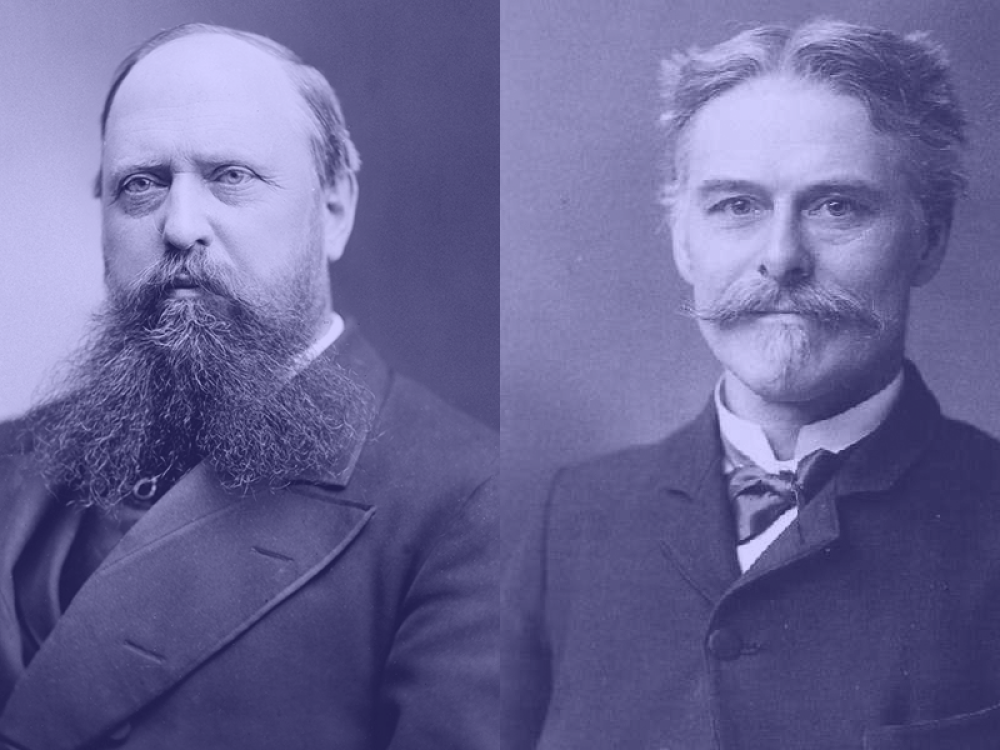
[00:03:35] The first of them, Edward Drinker Cope, was born in Philadelphia in 1840, into a wealthy family of Quakers, members of a quiet and strict Christian community.
[00:03:50] He was a child prodigy. He was studying anatomy as a boy, publishing scientific papers as a teenager, and by his early twenties he had a reputation as one of the sharpest minds in American natural history.
[00:04:08] He was also, by all accounts, a difficult man: he was charming, but he was also hot-tempered, and completely incapable of backing down from a fight.
[00:04:21] His rival was a man with the magnificent name of Othniel Charles Marsh, and he was almost the opposite. He was born nine years earlier, in 1831, on a poor farm in upstate New York. His mother died when he was a small boy. There was no money and, for a long time, no obvious future.
[00:04:48] But Marsh had one great piece of luck: his uncle was a man called George Peabody, who just so happened to be one of the richest bankers in the world.
[00:05:03] Peabody paid for his nephew's education, first at school, then at Yale.
[00:05:10] And Marsh, who was slow, methodical and extremely patient, made the most of it. He studied hard, and became the first professor of palaeontology in the United States.
[00:05:24] And palaeontology, by the way, isn't only about dinosaurs; it's simply the study of ancient life through fossils, the most interesting of which tend to be dinosaurs.
[00:05:37] And although the subject matter is, by definition, ancient, the discipline isn't; in the 1860s, when this was all taking place, it was a brand new science.
[00:05:52] Darwin's On the Origin of Species had been published in 1859, which meant that suddenly every fossil became potential evidence, evidence of evolution.
[00:06:04] So, we have Edward Cope and Othniel Marsh, two great young palaeontologists cutting their teeth in the very first days of palaeontology.
[00:06:16] And as you heard, before they were rivals, they were friends.
[00:06:21] The friendship began in Berlin, in 1864. Cope was twenty-three, touring the great museums and universities of Europe. Marsh was thirty-two, and finishing his studies.
[00:06:35] They were young, a long way from home, and American palaeontologists were few and far between; there weren't many of them.
[00:06:45] They went to museums together, walked and talked, and exchanged letters and photographs when they parted.
[00:06:54] When they got home, they even named newly discovered species after each other, which is kind of cute, almost flirty, even.
[00:07:04] So what went wrong?
[00:07:07] The first crack came in 1868, in a muddy pit in New Jersey.
[00:07:15] Cope was working the marl pits of Haddonfield, quarries near Philadelphia where workers digging fertiliser kept turning up ancient bones.
[00:07:27] This was sacred ground for American palaeontology. A decade earlier, one of the first nearly complete dinosaur skeletons ever found, Hadrosaurus, had been dug out of these pits.
[00:07:42] Cope generously invited his friend Marsh down from Yale and showed him around.
[00:07:49] Marsh smiled, admired the fossils, thanked his host, and went home.
[00:07:56] But whether down there in the pit, or dreamed up months before, he had hatched a dastardly plan. He secretly paid the pit operators to send their future discoveries not to Cope, but to him, at Yale.
[00:08:16] When Cope found out, he was furious.
[00:08:21] Then came the affair of the backwards sea monster.
[00:08:26] In March of 1868, a large wooden crate arrived at the Academy of Natural Sciences in Philadelphia.
[00:08:36] Inside it were bones. Huge, strange bones, dug out of the rocks of western Kansas and sent east by an army doctor.
[00:08:47] Cope opened the crate and got to work. He laid out the bones, studied them, and pieced together a creature unlike anything anyone had ever seen: a giant sea reptile with a short neck and an extraordinarily long, snake-like tail.
[00:09:09] He named it Elasmosaurus. He presented it to his colleagues, published a paper, and included a beautiful illustration of the reconstructed skeleton.
[00:09:22] There was just one problem, a problem you might be familiar with if you are the sort of person who doesn't properly read the IKEA instructions.
[00:09:32] Cope put the head on the wrong end.
[00:09:36] The real animal had a long, swan-like neck and a short tail. Cope had rebuilt it backwards, and mistaken the neck for a tail.
[00:09:49] The mistake was pointed out publicly two years later, at a scientific meeting, by an older professor. It was done politely, as these things tended to be done. After all, a neck does look a bit like a tail, and putting the bits of a puzzle together is harder still if you don't even know what the final thing is meant to look like.
[00:10:12] Cope, understandably, was mortified. He tried to buy back every printed copy of his paper so that the error would disappear from the record.
[00:10:23] He managed to buy back all but one. One copy remained in the hands of his former friend, Othniel Charles Marsh.
[00:10:33] He kept it, and he would retell the story of the backwards sea monster, with great pleasure, for the next thirty years.
[00:10:43] By the early 1870s, the friendship was dead. What replaced it was a competition unlike anything science had seen before.
[00:10:55] The battlefield was the American West.
[00:10:59] The first railway across the American continent had just been completed, and it cut straight through some of the richest fossil country on Earth: Kansas, Wyoming, Colorado, and Nebraska.
[00:11:13] Railway cuttings and eroded hillsides were spilling out the bones of these great creatures nobody had ever studied before.
[00:11:21] For a palaeontologist, this was a gold rush. And Cope and Marsh raced each other into it like rival prospectors.
[00:11:33] It was not gentle work. The fossil country was dry, empty land, blazing hot in summer and bitterly cold in winter. Much of it was badlands: bare, broken, eroded country where almost nothing grows.
[00:11:53] Collectors worked there with picks and shovels, the nearest town sometimes days away by wagon. They drank foul water, breathed bitter mineral dust, and slept under canvas.
[00:12:08] Then, in 1877, everything exploded.
[00:12:14] That year, a schoolteacher in Colorado named Arthur Lakes wrote to Marsh about some enormous bones he had found sticking out of a hillside. When Marsh was slow to reply, Lakes wrote to Cope as well.
[00:12:33] That got Marsh's attention. He sent money immediately, hired Lakes, and told him to keep everything secret.
[00:12:43] A few months later, in the summer of 1877, Marsh received another letter, this time from Laramie, a small railway town in Wyoming.
[00:12:56] It came from two men who worked on the railway at a lonely little station called Como. They had found a large number of fossils, they said, some of them enormous, not far from where they lived.
[00:13:13] But they were very careful about what they gave away.
[00:13:18] They signed the letter with their middle names, Harlow and Edwards, instead of their real ones.
[00:13:24] They posted it from Laramie, so that the postmark would not point to Como. And they said nothing about where the bones actually were.
[00:13:35] What they were offering, they explained, was to sell Marsh their fossils “and also the secret of the others”. They were working men, they wrote, and they could not afford to give them away as a gift.
[00:13:48] Marsh, on the other hand, was well known as “a man of means”, a rich man.
[00:13:55] The location, in other words, was the thing for sale. If they told Marsh where the bones were, there was nothing to stop him sending his own men to dig them up, and paying the two of them nothing at all.
[00:14:09] They also mentioned, helpfully, that other people in the area were “looking for such things”.
[00:14:16] Marsh did not need to be told who that might be.
[00:14:20] He sent them a cheque immediately. But their anonymity came back to bite them. The cheque was made out to Harlow and Edwards, their middle names, so the men could not cash it.
[00:14:36] Marsh then sent one of his assistants out to Wyoming to check whether the story was true. It was. The bones ran along a long, low ridge called Como Bluff, and it turned out to be one of the greatest dinosaur sites ever discovered.
[00:14:58] Marsh signed the two men up on a monthly wage, with bonuses for important finds, and told them to keep Cope out.
[00:15:08] They were right to be careful. Within two years, Cope's spies had found out about Como Bluff, and Cope's collectors had set up camp practically next door. One of Marsh's own men, unhappy with his pay, switched sides and started digging for the enemy.
[00:15:29] What followed was less like science and more like a small, strange war.
[00:15:36] Each man built a network of field collectors, spies and informants. Telegrams were sent in code, so that rival agents reading them would not learn what had been found.
[00:15:50] Workers were bribed to reveal secrets, or to keep them. Crews spied on each other's quarries, and occasionally threw stones at each other.
[00:16:01] The digging did not even stop for winter. At Como Bluff, Marsh's men kept working through the bitter Wyoming blizzards, hacking bones out of frozen rock, because a quarry left unattended, well, it was unattended, and fair game for the other side.
[00:16:21] And when a digging season ended for good, some crews would fill their quarries back in with earth and rock, or even, it was rumoured, smash the smaller bones that remained, rather than leave anything behind for their dinosaur-digging rivals.
[00:16:39] Back east, the war was fought in scientific journals.
[00:16:45] In the 1870s and 1880s, the two men were publishing at a furious pace, racing to be the first to name each new species. The rules of science, after all, are quite simple as far as this is concerned: whoever publishes a valid name first, wins, and that becomes the name of the creature.
[00:17:08] So speed was everything. Cope in particular would rush descriptions into print within days, sometimes within hours, of a crate of bones arriving.
[00:17:21] Marsh accused him of writing false, earlier dates on his papers to win the race.
[00:17:27] Cope accused Marsh of everything from plagiarism to scientific fraud.
[00:17:33] The pace produced chaos. Between them, the two men named more than 140 species of dinosaur. Many of these later turned out to be duplicates, the same animal named twice, or three times, from different piles of bones.
[00:17:54] In 1877, for example, Marsh named a huge long-necked plant-eater Apatosaurus. Two years later, working from another skeleton, he named another one Brontosaurus, the "thunder lizard".
[00:18:11] They were, it later emerged, essentially the same animal, and the name Brontosaurus was officially retired for most of a century. Though, in a nice twist, some modern palaeontologists have argued for bringing it back.
[00:18:28] Cope, for his part, found a way to weaponise even the naming of species. In 1884, he named a small fossil mammal Anisonchus cophater.
[00:18:42] A colleague asked him about the Greek origin of the word "cophater". Cope cheerfully explained that it was not Greek at all. It was simply "Cope-hater", in honour, he said, of all the Cope-haters who surrounded him.
[00:18:58] And at the top of that list, of course, was Othniel Charles Marsh.
[00:19:03] And to think, these were men who had previously named discoveries after each other out of mutual admiration.
[00:19:12] But strip away the pettiness, and the scientific haul from these years is enormous.
[00:19:19] From Marsh's quarries came Stegosaurus, with its plated back. Allosaurus, the great predator of the Jurassic. Diplodocus, one of the longest animals ever to walk the Earth.
[00:19:34] And, near the end, Triceratops, the three-horned giant that has decorated children's bedrooms ever since.
[00:19:42] Cope named the Camarasaurus, the most common giant of the American Jurassic, and Coelophysis, one of the earliest dinosaurs ever known.
[00:19:53] He described hundreds of other ancient creatures, from fossil fish to flying reptiles, in a lifetime output of around 1,400 scientific papers, a number that has probably never been matched.
[00:20:08] Museums on the east coast filled up, crate by crate, with creatures no human being had ever imagined. Newspapers picked up the story. The public, for the first time, fell in love with dinosaurs.
[00:20:24] But wars are expensive, and this one was consuming both men.
[00:20:31] Cope had inherited a fortune, and he spent essentially all of it: on collectors, on shipments, on buying a scientific journal to guarantee himself somewhere to publish quickly. What remained, he invested in silver mines that failed.
[00:20:50] By the late 1880s, this man from one of Philadelphia's wealthiest families was renting out his house and living among his fossil crates, low on money and low on friends.
[00:21:05] Marsh had the safer position. He had Yale, the Peabody money, and from 1882 a powerful official post as chief palaeontologist of the United States Geological Survey.
[00:21:20] So Cope, broke and bitter, decided that if he was going down, Marsh was coming with him.
[00:21:29] He had spent years keeping a journal of every accusation, every rumour and every complaint against Marsh: from underpaid field workers, from junior scientists whose work Marsh had published under his own name, from anyone with a grudge. He handed the whole file to a journalist at the New York Herald.
[00:21:53] On the 12th of January 1890, the story ran with the headline "Scientists Wage Bitter Warfare".
[00:22:03] It was, by all accounts, a badly researched and badly written article. Still, it was a sensation. America's two most famous scientists were suddenly accusing each other of theft, fraud and incompetence in the pages of a national newspaper, day after day, like two men brawling in the street.
[00:22:27] Nobody won.
[00:22:28] Cope gained little except the satisfaction of a public fight. Marsh was wounded badly. The scandal drew attention to his government position, and in 1892, when Congress was looking for budgets to cut, his funding was an easy target. He was forced to resign.
[00:22:51] The last years of both men were quiet and rather sad. And they never buried the hatchet: they never apologised to each other.
[00:23:03] Cope sold off a large part of his beloved fossil collection to the American Museum of Natural History to pay his bills. He died in 1897, at the age of fifty-six, in a room stacked with fossil crates, sleeping on a camp bed surrounded by his specimens.
[00:23:24] Even in death, he could not quite let go. He donated his body to science, and the story goes that he wanted his skull to be measured. Brain size, at the time, was believed to be a mark of intelligence, and Cope expected Marsh to accept the same challenge, skull against skull.
[00:23:48] Marsh did not. He died two years later, in 1899. The man who had spent a banker's fortune on bones had but a few hundred dollars in the bank, a mortgaged house, and the greatest fossil collection in America, which he duly left to Yale.
[00:24:08] But despite the somewhat unglamorous end for both of its participants, the Bone Wars was a hugely productive period in terms of our understanding of dinosaurs.
[00:24:21] When Cope and Marsh started work, science knew of nine species of dinosaur from the whole of North America, most of them from scraps and fragments. When they finished, there were more than 140, including nearly all of the famous names: Stegosaurus, Triceratops, Diplodocus, Allosaurus, the list goes on.
[00:24:46] They filled the great museums of America. They turned palaeontology into a proper, professional science, and they turned the dinosaur into a public obsession, which it has remained ever since.
[00:25:00] Indeed, it became famous enough that, a century later, television writers could put a palaeontologist on a sofa in a New York coffee shop and everyone would know what that meant.
[00:25:13] And over the decades that followed, one particular picture of dinosaurs came to dominate: giant, slow, cold-blooded, stupid reptiles, dragging their tails through the swamps of a vanished world.
[00:25:29] That picture went into every museum and every textbook for the next hundred years.
[00:25:35] And it was almost completely wrong.
[00:25:39] But that is the story of part two.
[00:25:43] OK, then, that is it for today's episode — the first part of our three-part mini-series on dinosaurs.
[00:25:50] Next up we'll be moving into the story of how science got dinosaurs wrong for a hundred years, and the discovery of a single claw that changed everything.
[00:26:01] And in part three, we'll go back sixty-six million years and follow, hour by hour, what happened on the day the dinosaurs died.
[00:26:10] You've been listening to English Learning for Curious Minds by Leonardo English.
[00:26:16] I'm Alastair Budge, you stay safe, and I'll catch you in the next episode.
Join today and get instant access to 600+ episodes, interactive transcripts, PDF study packs and more.
Become a memberAlready a member? Login
30-day money back guarantee. Cancel anytime.

In the late 1800s, two American scientists turned the hunt for dinosaur bones into a twenty-year war of bribery, spying and smashed fossils. It ruined them both, and almost by accident, it gave the world the dinosaurs.

[00:00:05] Hello, hello, hello, and welcome to English Learning for Curious Minds, by Leonardo English, the show where you can listen to fascinating stories and learn weird and wonderful things about the world at the same time as improving your English.
[00:00:22] I'm Alastair Budge, and today it's the start of another three-part mini-series, this time on dinosaurs.
[00:00:30] In today's episode, we are going to hear the story of the Bone Wars, the bitter twenty-year feud between two American scientists that gave the world Stegosaurus, Triceratops and Diplodocus, and very nearly destroyed both men in the process.
[00:00:50] In part two, we'll find out how science managed to get dinosaurs almost completely wrong for a hundred years, and how a single claw dug up in Montana changed everything.
[00:01:03] And in part three, we'll travel back sixty-six million years to the last day of the dinosaurs, and follow what happened, hour by hour, after an asteroid crashed into the Earth.
[00:01:16] OK then, let's not waste a minute and get right into it. If you have ever watched the hugely popular American TV series Friends, your lasting memory might be that they seem to spend a lot of time sitting around drinking coffee. Some of them, however, did have jobs.
[00:01:39] Rachel, you might remember, worked at the coffee shop.
[00:01:43] Joey had dreams of becoming an actor; he just wasn't a very good one.
[00:01:48] Monica was a chef.
[00:01:51] And Ross was a palaeontologist, an expert in dinosaurs.
[00:01:57] He was given that job, no doubt, because he was meant to be a little bit odd, a little antisocial, perhaps, and not particularly interesting.
[00:02:08] After all, unless you are five years old, the world of dinosaur discovery might seem a little... slow, uninteresting. You are dealing with objects from millions of years ago, dusting off bones, filing away things in drawers.
[00:02:27] With all due respect to any palaeontologists who might be listening to this, it's possible to think that dinosaurs are fascinating but to not want to spend your life studying them.
[00:02:40] The early years of palaeontology, however, were anything but dull. They were shaped by a great rivalry, the greatest rivalry in the history of the subject, and perhaps one of the greatest rivalries in the history of science.
[00:02:59] It has been called the Bone Wars. It ran for more than two decades, and it involved bribery, spying, theft, smashed fossils, and a full-scale public scandal on the front page of a New York newspaper.
[00:03:18] It ruined the two men at the centre of it. It also, almost by accident, gave the world the dinosaurs.
[00:03:27] And like many a great rivalry, the rivals started out as friends.
[00:03:35] The first of them, Edward Drinker Cope, was born in Philadelphia in 1840, into a wealthy family of Quakers, members of a quiet and strict Christian community.
[00:03:50] He was a child prodigy. He was studying anatomy as a boy, publishing scientific papers as a teenager, and by his early twenties he had a reputation as one of the sharpest minds in American natural history.
[00:04:08] He was also, by all accounts, a difficult man: he was charming, but he was also hot-tempered, and completely incapable of backing down from a fight.
[00:04:21] His rival was a man with the magnificent name of Othniel Charles Marsh, and he was almost the opposite. He was born nine years earlier, in 1831, on a poor farm in upstate New York. His mother died when he was a small boy. There was no money and, for a long time, no obvious future.
[00:04:48] But Marsh had one great piece of luck: his uncle was a man called George Peabody, who just so happened to be one of the richest bankers in the world.
[00:05:03] Peabody paid for his nephew's education, first at school, then at Yale.
[00:05:10] And Marsh, who was slow, methodical and extremely patient, made the most of it. He studied hard, and became the first professor of palaeontology in the United States.
[00:05:24] And palaeontology, by the way, isn't only about dinosaurs; it's simply the study of ancient life through fossils, the most interesting of which tend to be dinosaurs.
[00:05:37] And although the subject matter is, by definition, ancient, the discipline isn't; in the 1860s, when this was all taking place, it was a brand new science.
[00:05:52] Darwin's On the Origin of Species had been published in 1859, which meant that suddenly every fossil became potential evidence, evidence of evolution.
[00:06:04] So, we have Edward Cope and Othniel Marsh, two great young palaeontologists cutting their teeth in the very first days of palaeontology.
[00:06:16] And as you heard, before they were rivals, they were friends.
[00:06:21] The friendship began in Berlin, in 1864. Cope was twenty-three, touring the great museums and universities of Europe. Marsh was thirty-two, and finishing his studies.
[00:06:35] They were young, a long way from home, and American palaeontologists were few and far between; there weren't many of them.
[00:06:45] They went to museums together, walked and talked, and exchanged letters and photographs when they parted.
[00:06:54] When they got home, they even named newly discovered species after each other, which is kind of cute, almost flirty, even.
[00:07:04] So what went wrong?
[00:07:07] The first crack came in 1868, in a muddy pit in New Jersey.
[00:07:15] Cope was working the marl pits of Haddonfield, quarries near Philadelphia where workers digging fertiliser kept turning up ancient bones.
[00:07:27] This was sacred ground for American palaeontology. A decade earlier, one of the first nearly complete dinosaur skeletons ever found, Hadrosaurus, had been dug out of these pits.
[00:07:42] Cope generously invited his friend Marsh down from Yale and showed him around.
[00:07:49] Marsh smiled, admired the fossils, thanked his host, and went home.
[00:07:56] But whether down there in the pit, or dreamed up months before, he had hatched a dastardly plan. He secretly paid the pit operators to send their future discoveries not to Cope, but to him, at Yale.
[00:08:16] When Cope found out, he was furious.
[00:08:21] Then came the affair of the backwards sea monster.
[00:08:26] In March of 1868, a large wooden crate arrived at the Academy of Natural Sciences in Philadelphia.
[00:08:36] Inside it were bones. Huge, strange bones, dug out of the rocks of western Kansas and sent east by an army doctor.
[00:08:47] Cope opened the crate and got to work. He laid out the bones, studied them, and pieced together a creature unlike anything anyone had ever seen: a giant sea reptile with a short neck and an extraordinarily long, snake-like tail.
[00:09:09] He named it Elasmosaurus. He presented it to his colleagues, published a paper, and included a beautiful illustration of the reconstructed skeleton.
[00:09:22] There was just one problem, a problem you might be familiar with if you are the sort of person who doesn't properly read the IKEA instructions.
[00:09:32] Cope put the head on the wrong end.
[00:09:36] The real animal had a long, swan-like neck and a short tail. Cope had rebuilt it backwards, and mistaken the neck for a tail.
[00:09:49] The mistake was pointed out publicly two years later, at a scientific meeting, by an older professor. It was done politely, as these things tended to be done. After all, a neck does look a bit like a tail, and putting the bits of a puzzle together is harder still if you don't even know what the final thing is meant to look like.
[00:10:12] Cope, understandably, was mortified. He tried to buy back every printed copy of his paper so that the error would disappear from the record.
[00:10:23] He managed to buy back all but one. One copy remained in the hands of his former friend, Othniel Charles Marsh.
[00:10:33] He kept it, and he would retell the story of the backwards sea monster, with great pleasure, for the next thirty years.
[00:10:43] By the early 1870s, the friendship was dead. What replaced it was a competition unlike anything science had seen before.
[00:10:55] The battlefield was the American West.
[00:10:59] The first railway across the American continent had just been completed, and it cut straight through some of the richest fossil country on Earth: Kansas, Wyoming, Colorado, and Nebraska.
[00:11:13] Railway cuttings and eroded hillsides were spilling out the bones of these great creatures nobody had ever studied before.
[00:11:21] For a palaeontologist, this was a gold rush. And Cope and Marsh raced each other into it like rival prospectors.
[00:11:33] It was not gentle work. The fossil country was dry, empty land, blazing hot in summer and bitterly cold in winter. Much of it was badlands: bare, broken, eroded country where almost nothing grows.
[00:11:53] Collectors worked there with picks and shovels, the nearest town sometimes days away by wagon. They drank foul water, breathed bitter mineral dust, and slept under canvas.
[00:12:08] Then, in 1877, everything exploded.
[00:12:14] That year, a schoolteacher in Colorado named Arthur Lakes wrote to Marsh about some enormous bones he had found sticking out of a hillside. When Marsh was slow to reply, Lakes wrote to Cope as well.
[00:12:33] That got Marsh's attention. He sent money immediately, hired Lakes, and told him to keep everything secret.
[00:12:43] A few months later, in the summer of 1877, Marsh received another letter, this time from Laramie, a small railway town in Wyoming.
[00:12:56] It came from two men who worked on the railway at a lonely little station called Como. They had found a large number of fossils, they said, some of them enormous, not far from where they lived.
[00:13:13] But they were very careful about what they gave away.
[00:13:18] They signed the letter with their middle names, Harlow and Edwards, instead of their real ones.
[00:13:24] They posted it from Laramie, so that the postmark would not point to Como. And they said nothing about where the bones actually were.
[00:13:35] What they were offering, they explained, was to sell Marsh their fossils “and also the secret of the others”. They were working men, they wrote, and they could not afford to give them away as a gift.
[00:13:48] Marsh, on the other hand, was well known as “a man of means”, a rich man.
[00:13:55] The location, in other words, was the thing for sale. If they told Marsh where the bones were, there was nothing to stop him sending his own men to dig them up, and paying the two of them nothing at all.
[00:14:09] They also mentioned, helpfully, that other people in the area were “looking for such things”.
[00:14:16] Marsh did not need to be told who that might be.
[00:14:20] He sent them a cheque immediately. But their anonymity came back to bite them. The cheque was made out to Harlow and Edwards, their middle names, so the men could not cash it.
[00:14:36] Marsh then sent one of his assistants out to Wyoming to check whether the story was true. It was. The bones ran along a long, low ridge called Como Bluff, and it turned out to be one of the greatest dinosaur sites ever discovered.
[00:14:58] Marsh signed the two men up on a monthly wage, with bonuses for important finds, and told them to keep Cope out.
[00:15:08] They were right to be careful. Within two years, Cope's spies had found out about Como Bluff, and Cope's collectors had set up camp practically next door. One of Marsh's own men, unhappy with his pay, switched sides and started digging for the enemy.
[00:15:29] What followed was less like science and more like a small, strange war.
[00:15:36] Each man built a network of field collectors, spies and informants. Telegrams were sent in code, so that rival agents reading them would not learn what had been found.
[00:15:50] Workers were bribed to reveal secrets, or to keep them. Crews spied on each other's quarries, and occasionally threw stones at each other.
[00:16:01] The digging did not even stop for winter. At Como Bluff, Marsh's men kept working through the bitter Wyoming blizzards, hacking bones out of frozen rock, because a quarry left unattended, well, it was unattended, and fair game for the other side.
[00:16:21] And when a digging season ended for good, some crews would fill their quarries back in with earth and rock, or even, it was rumoured, smash the smaller bones that remained, rather than leave anything behind for their dinosaur-digging rivals.
[00:16:39] Back east, the war was fought in scientific journals.
[00:16:45] In the 1870s and 1880s, the two men were publishing at a furious pace, racing to be the first to name each new species. The rules of science, after all, are quite simple as far as this is concerned: whoever publishes a valid name first, wins, and that becomes the name of the creature.
[00:17:08] So speed was everything. Cope in particular would rush descriptions into print within days, sometimes within hours, of a crate of bones arriving.
[00:17:21] Marsh accused him of writing false, earlier dates on his papers to win the race.
[00:17:27] Cope accused Marsh of everything from plagiarism to scientific fraud.
[00:17:33] The pace produced chaos. Between them, the two men named more than 140 species of dinosaur. Many of these later turned out to be duplicates, the same animal named twice, or three times, from different piles of bones.
[00:17:54] In 1877, for example, Marsh named a huge long-necked plant-eater Apatosaurus. Two years later, working from another skeleton, he named another one Brontosaurus, the "thunder lizard".
[00:18:11] They were, it later emerged, essentially the same animal, and the name Brontosaurus was officially retired for most of a century. Though, in a nice twist, some modern palaeontologists have argued for bringing it back.
[00:18:28] Cope, for his part, found a way to weaponise even the naming of species. In 1884, he named a small fossil mammal Anisonchus cophater.
[00:18:42] A colleague asked him about the Greek origin of the word "cophater". Cope cheerfully explained that it was not Greek at all. It was simply "Cope-hater", in honour, he said, of all the Cope-haters who surrounded him.
[00:18:58] And at the top of that list, of course, was Othniel Charles Marsh.
[00:19:03] And to think, these were men who had previously named discoveries after each other out of mutual admiration.
[00:19:12] But strip away the pettiness, and the scientific haul from these years is enormous.
[00:19:19] From Marsh's quarries came Stegosaurus, with its plated back. Allosaurus, the great predator of the Jurassic. Diplodocus, one of the longest animals ever to walk the Earth.
[00:19:34] And, near the end, Triceratops, the three-horned giant that has decorated children's bedrooms ever since.
[00:19:42] Cope named the Camarasaurus, the most common giant of the American Jurassic, and Coelophysis, one of the earliest dinosaurs ever known.
[00:19:53] He described hundreds of other ancient creatures, from fossil fish to flying reptiles, in a lifetime output of around 1,400 scientific papers, a number that has probably never been matched.
[00:20:08] Museums on the east coast filled up, crate by crate, with creatures no human being had ever imagined. Newspapers picked up the story. The public, for the first time, fell in love with dinosaurs.
[00:20:24] But wars are expensive, and this one was consuming both men.
[00:20:31] Cope had inherited a fortune, and he spent essentially all of it: on collectors, on shipments, on buying a scientific journal to guarantee himself somewhere to publish quickly. What remained, he invested in silver mines that failed.
[00:20:50] By the late 1880s, this man from one of Philadelphia's wealthiest families was renting out his house and living among his fossil crates, low on money and low on friends.
[00:21:05] Marsh had the safer position. He had Yale, the Peabody money, and from 1882 a powerful official post as chief palaeontologist of the United States Geological Survey.
[00:21:20] So Cope, broke and bitter, decided that if he was going down, Marsh was coming with him.
[00:21:29] He had spent years keeping a journal of every accusation, every rumour and every complaint against Marsh: from underpaid field workers, from junior scientists whose work Marsh had published under his own name, from anyone with a grudge. He handed the whole file to a journalist at the New York Herald.
[00:21:53] On the 12th of January 1890, the story ran with the headline "Scientists Wage Bitter Warfare".
[00:22:03] It was, by all accounts, a badly researched and badly written article. Still, it was a sensation. America's two most famous scientists were suddenly accusing each other of theft, fraud and incompetence in the pages of a national newspaper, day after day, like two men brawling in the street.
[00:22:27] Nobody won.
[00:22:28] Cope gained little except the satisfaction of a public fight. Marsh was wounded badly. The scandal drew attention to his government position, and in 1892, when Congress was looking for budgets to cut, his funding was an easy target. He was forced to resign.
[00:22:51] The last years of both men were quiet and rather sad. And they never buried the hatchet: they never apologised to each other.
[00:23:03] Cope sold off a large part of his beloved fossil collection to the American Museum of Natural History to pay his bills. He died in 1897, at the age of fifty-six, in a room stacked with fossil crates, sleeping on a camp bed surrounded by his specimens.
[00:23:24] Even in death, he could not quite let go. He donated his body to science, and the story goes that he wanted his skull to be measured. Brain size, at the time, was believed to be a mark of intelligence, and Cope expected Marsh to accept the same challenge, skull against skull.
[00:23:48] Marsh did not. He died two years later, in 1899. The man who had spent a banker's fortune on bones had but a few hundred dollars in the bank, a mortgaged house, and the greatest fossil collection in America, which he duly left to Yale.
[00:24:08] But despite the somewhat unglamorous end for both of its participants, the Bone Wars was a hugely productive period in terms of our understanding of dinosaurs.
[00:24:21] When Cope and Marsh started work, science knew of nine species of dinosaur from the whole of North America, most of them from scraps and fragments. When they finished, there were more than 140, including nearly all of the famous names: Stegosaurus, Triceratops, Diplodocus, Allosaurus, the list goes on.
[00:24:46] They filled the great museums of America. They turned palaeontology into a proper, professional science, and they turned the dinosaur into a public obsession, which it has remained ever since.
[00:25:00] Indeed, it became famous enough that, a century later, television writers could put a palaeontologist on a sofa in a New York coffee shop and everyone would know what that meant.
[00:25:13] And over the decades that followed, one particular picture of dinosaurs came to dominate: giant, slow, cold-blooded, stupid reptiles, dragging their tails through the swamps of a vanished world.
[00:25:29] That picture went into every museum and every textbook for the next hundred years.
[00:25:35] And it was almost completely wrong.
[00:25:39] But that is the story of part two.
[00:25:43] OK, then, that is it for today's episode — the first part of our three-part mini-series on dinosaurs.
[00:25:50] Next up we'll be moving into the story of how science got dinosaurs wrong for a hundred years, and the discovery of a single claw that changed everything.
[00:26:01] And in part three, we'll go back sixty-six million years and follow, hour by hour, what happened on the day the dinosaurs died.
[00:26:10] You've been listening to English Learning for Curious Minds by Leonardo English.
[00:26:16] I'm Alastair Budge, you stay safe, and I'll catch you in the next episode.