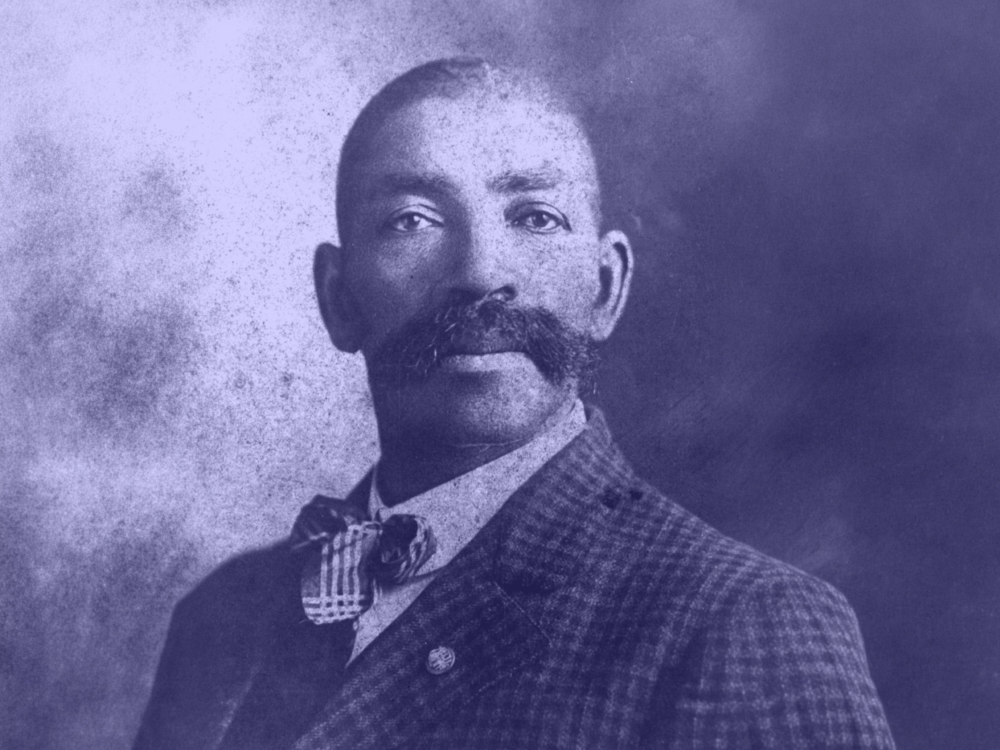
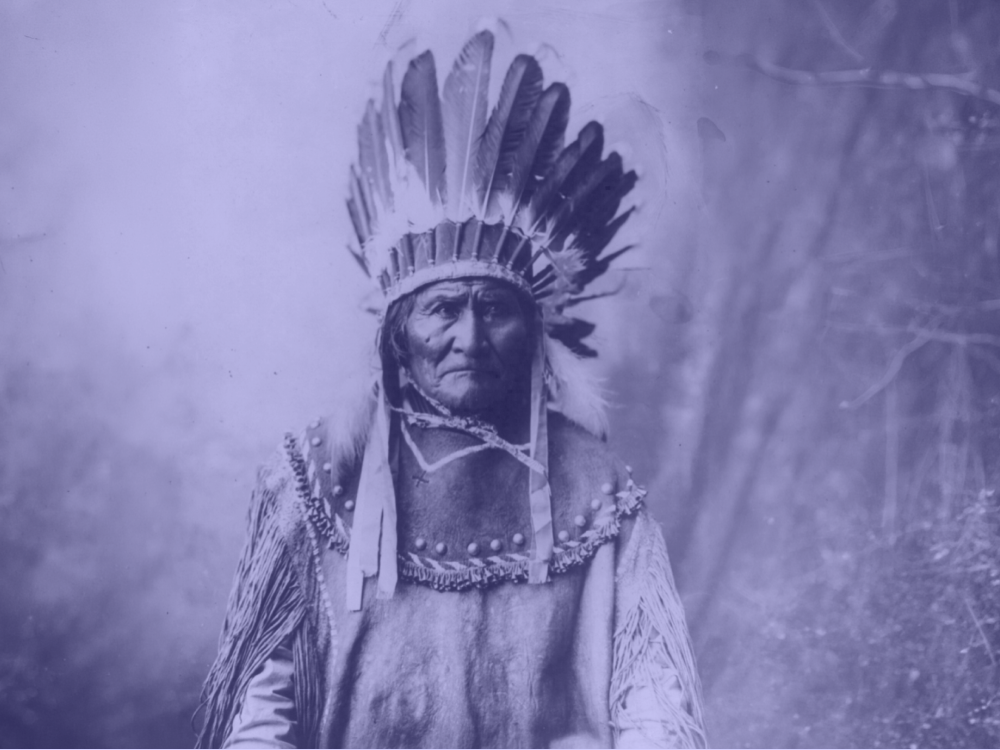
In 1851, Mexican soldiers killed Geronimo's mother, wife, and three children. He spent the rest of his life trying to make them pay.
For decades, the Apache leader raided across the deserts of Mexico and the American Southwest, slipping past thousands of soldiers sent to catch him.
His surrender in 1886 closed the last chapter of the Indian Wars. But the strangest part of his life, as a celebrity prisoner of the United States government, was only just beginning.
Tap a purple word for its meaning. Tap a time to play from there.
[00:00:04] Hello, hello, hello, and welcome to English Learning for Curious Minds, by Leonardo English, the show where you can listen to fascinating stories and learn weird and wonderful things about the world at the same time as improving your English.
[00:00:21] I’m Alastair Budge, and this is the third and final part of our mini-series, Tales from the Wild West.
[00:00:30] In part one, we looked at Wyatt Earp, and the gap between the man and the legend.
[00:00:37] In part two, we met Bass Reeves: the most feared lawman in the West.
[00:00:43] And today, we are going to look at the West from a completely different angle.
[00:00:49] Not cowboys, not lawmen, not outlaws, but the people who were there before everyone else arrived.
[00:00:57] And the story of one man in particular: Geronimo, the so-called “worst Indian who ever lived”, a man who was feared as a murderer, celebrated as a warrior, displayed as a curiosity, and remembered as a symbol of resistance.
[00:01:15] So, let’s not waste a minute, and get right into it.
[00:01:20] It is March, 1851.
[00:01:23] A group of Apache men, women, and children are camped near the Mexican town of Janos, in the state of Chihuahua. The men have gone into town to trade. They leave their families at the camp.
[00:01:40] While they are gone, Mexican soldiers under the command of Colonel José María Carrasco ride into the camp.
[00:01:50] The soldiers kill the women. They kill the children. They kill the elderly. When the trading party returns, they find the lifeless bodies of their loved ones.
[00:02:04] One young man finds his wife, his three children, and his mother. All of them, slaughtered.
[00:02:14] That man is a twenty-one-year-old named Goyaałé.
[00:02:20] He stands at the edge of the camp and looks at what has been done.
[00:02:25] He never speaks about what exactly he felt in that moment.
[00:02:30] But what we do know is that, there and then, he made a solemn vow to avenge his family.
[00:02:39] And he would spend the next thirty-five years doing it.
[00:02:45] This man, Goyaałé, was born in June 1829, in what is now the borderlands between Arizona and New Mexico. He was Chiricahua Apache, one of several Apache groups who had lived in this area for centuries.
[00:03:04] Now, the Apache were not a single unified nation in the way that European nations understood nationhood. They were a collection of bands, loosely connected by language and shared territory. They were skilled at moving quickly over difficult ground, and at living with very little. The desert and the mountains, these were their home.
[00:03:32] And to clarify, the Apache were not the “Indians” of Western films. There were no feathered headdresses, no vast plains, no buffalo herds. They were desert people, mountain people, a nomadic people who moved with the seasons.
[00:03:52] They had lived on this land for centuries, but foreigners had been encroaching on it.
[00:03:59] First the Spanish, in the 17th century, and the Mexicans after independence from Spain in 1821.
[00:04:09] As such, Apache life was dominated by raids and counter raids: Apache warriors would attack Spanish and then Mexican camps, stealing food and horses, before retreating to the mountains. And the Spanish, and then the Mexicans, would chase after them.
[00:04:29] This was simply how life worked, a violent cycle of raiding.
[00:04:36] And Goyaałé grew up inside that cycle. Fighting. Raiding. Retreating to the mountains.
[00:04:45] And this was further complicated in 1848, when the war between the United States and Mexico ended with an American victory. This meant that a new international border now cut straight through Apache territory.
[00:05:05] What had been Mexican land, and Apache land long before that, was now American, and American settlers were beginning to move in.
[00:05:16] Three years later came the massacre at Janos.
[00:05:21] His wife. His children. His mother.
[00:05:24] And the solemn promise to avenge their death.
[00:05:29] Now, there are accounts that after the massacre, Goyaałé went alone into the forest to mourn his family.
[00:05:38] And there, he heard a voice. The voice said, “No gun will ever kill you. I will take the bullets from the guns of the Mexicans and I will guide your arrows.”
[00:05:54] And for decades, it would seem as if the voice had been right.
[00:05:59] Now, what followed was not a war in any formal sense. It was something more personal: a quest for revenge. Goyaałé could not identify the specific soldiers who had killed his family. So he did what Apache warriors had always done. He raided.
[00:06:21] But these raids were different. He was not after horses or cattle.
[00:06:26] He was going back to the same region, attacking the same Mexican military forces, again and again.
[00:06:35] There is no way of knowing how many people he killed, and to quote his later biography, “I have killed many Mexicans; I do not know how many, for frequently I did not count them.”
[00:06:48] These raids were fast, violent, and hard to defend against. A small band would strike at night or at dawn, take what they needed, kill anyone who got in their way, and be gone before a response could be organised.
[00:07:06] To Mexicans and later Americans on the frontier, Goyaałé, or should I say Geronimo, he was not a freedom fighter. He was a terror.
[00:07:18] As for the name Geronimo, there are several theories about where it came from. Perhaps it was the Mexican soldiers’ best attempt at pronouncing his name, Goyaałé, a name that I am no doubt slightly butchering here as well.
[00:07:34] The most common view is that Mexican soldiers would cry out to a saint called San Geronimo during the raids. And eventually, Goyaałé’s own people decided this was a good name to call him.
[00:07:48] However it came about, the name stuck, and became the name by which the world would know him.
[00:07:55] And with each raid, each skirmish, his reputation grew. He fought in the desert, in temperatures that could reach fifty degrees Celsius. He fought outnumbered, survived ambushes that he should not have survived, and escaped situations nobody could quite explain.
[00:08:16] On one occasion, he ran out of arrows while fighting Mexican soldiers. So he charged directly at them through the gunfire, zigzagging, closing the distance, and killed them with his knife. He came out unscathed.
[00:08:35] Among his own people, there were stories that he had gifts that went beyond ordinary courage: that he had visions, that he could not be hit by bullets, that he could sense danger before it arrived.
[00:08:50] Still, even after years of violence and the seeming thirst for revenge, there were moments when peace seemed possible.
[00:09:01] In 1873, the Apache and the Mexicans met and agreed to a peace treaty. Geronimo was among those present.
[00:09:11] Once the terms were signed, the Mexicans brought out the mezcal to celebrate.
[00:09:17] But when they were drunk, Mexican soldiers attacked and killed twenty Apaches. Somehow, Geronimo managed to escape.
[00:09:29] As you might imagine, from that point on he was not keen to negotiate, and the cycle of raiding and revenge resumed.
[00:09:40] What’s more, by this time, by the 1870s, Geronimo had a new and more powerful enemy: the United States.
[00:09:51] After the Mexican-American war, American settlers, soldiers and officials had begun pressing deeper into Apache territory
[00:10:01] Their objective was to subdue the Apaches, and the tool to do so was the reservation.
[00:10:10] The reservation, in the American context, was a defined area of land set aside for a Native people to live on, which was typically a fraction of their previous territory. The policy was assimilation: make them farmers, teach their children English, and eventually fold them into the new American nation.
[00:10:36] It rarely worked out that way. Reservation land was often unsuitable for agriculture. The promised food and supplies rarely arrived. The agents appointed to manage the reservations were frequently corrupt.
[00:10:52] The San Carlos Reservation, where Geronimo’s people were sent in 1876, had earned a nickname: Hell’s 40 Acres. It was an arid, disease-ridden wasteland, overcrowded and desperately undersupplied.
[00:11:11] Several times between the 1870s and late 1880s, Geronimo broke out of San Carlos and returned to the mountains. He continued the raiding in Mexico and in Arizona.
[00:11:27] He found himself being chased by thousands of American soldiers and hundreds of Mexican troops.
[00:11:34] His skill at escaping capture was such that the US Army sent one of its most experienced commanders to bring him in: General George Crook.
[00:11:46] In 1883, after tracking him high up into the mountains, and sending Apache scouts ahead to persuade Geronimo to negotiate, Crook and Geronimo finally met face-to-face.
[00:12:01] The conversation, reportedly, was blunt and factual. Crook told him the situation was unsustainable. Geronimo, who was no fool, agreed to return to the reservation.
[00:12:17] He did, and he stayed, for a while at least.
[00:12:22] Then the conditions deteriorated again. The food rations the government had promised failed to arrive. The land they had been allocated was barely farmable. It was miserable, an open prison.
[00:12:37] Then an Apache leader was arrested on dubious grounds. Geronimo clearly believed a similar fate might await him, and he was safer out, than in.
[00:12:51] In 1885 he left again, taking a small band of Apaches with him.
[00:12:57] This last flight would last over a year.
[00:13:02] Five thousand American soldiers, which was roughly one fifth of the entire United States Army, and five hundred Mexican soldiers were deployed to catch them, just one man and his small band.
[00:13:18] And the raids continued. Again and again, tiny Apache bands were able to strike, disappear into the mountains, and evade forces many times larger than themselves.
[00:13:33] To give you a sense of the numbers here, one estimate has it that in just the final five months of Geronimo’s campaign, a band of sixteen warriors killed between five hundred and six hundred Mexicans.
[00:13:51] The number may well be exaggerated. But if it’s even half of that, it gives you an idea of what he and his band were capable of.
[00:14:01] But by the mid-1880s, Geronimo was in his mid-fifties, and the arithmetic of the situation had become impossible. The band he was leading had shrunk. His people were exhausted. Mexico and the United States were working together to find him. There was nowhere left to go.
[00:14:25] By early 1886, Crook had tracked Geronimo deep into the mountains of Mexico, and the two men met again.
[00:14:35] Geronimo agreed to surrender. But that same night, a soldier from Crook’s column sold the band whiskey and told them they would be executed as soon as they crossed back into the United States.
[00:14:51] Geronimo fled.
[00:14:54] It was a deep humiliation for Crook, and he was replaced by another general called Nelson Miles.
[00:15:02] Miles was different. He was less patient, more conventional, and more interested in overwhelming force than in using Apache scouts. He pursued Geronimo with five thousand American soldiers.
[00:15:19] But it was to no avail. Miles, like Crook before him, was eventually forced to negotiate.
[00:15:28] He sent two officers ahead, along with a trusted Apache intermediary, to find Geronimo and propose a meeting. The message was simple: come and talk, or the pursuit continues until there is no one left.
[00:15:46] After several weeks of back-and-forth, Geronimo agreed.
[00:15:51] On the 4th of September, 1886, at a place called Skeleton Canyon in the mountains of southeastern Arizona, Geronimo came in from the mountains and gave up his rifle.
[00:16:06] He shook hands with General Nelson Miles of the United States Army.
[00:16:11] And surrendered.
[00:16:14] He was the last major leader of the Apache resistance. His surrender is often described as the end of the Indian Wars: the end, in some sense, of the entire era of large-scale armed Native American resistance to the conquest of their lands.
[00:16:33] He was fifty-seven years old. He had been fighting, more or less continuously, for thirty-five years. His band, by the time of the surrender, had shrunk to just thirty-eight people: men, women, and children.
[00:16:52] After his capture, many people wanted him executed. After all, he had led attacks that killed soldiers and civilians, and there were calls for him to be made an example of and hanged.
[00:17:08] It did not happen. The Army had classified Geronimo as a prisoner of war, not a criminal. Under the terms he had surrendered on, executing him was not an option. And there was a practical calculation too: if the Army hanged men who surrendered under terms, no future Apache leader would ever agree to talk.
[00:17:34] Dead, he would be a martyr. As a prisoner, he could be managed.
[00:17:40] Geronimo was led to believe that he and his people would be briefly imprisoned and then allowed to return to their land in Arizona.
[00:17:51] This did not happen, and what happened next was nothing short of betrayal.
[00:17:57] He and his band were loaded onto trains and transported to a military fort in Florida, thousands of kilometres from everything they had ever known.
[00:18:09] They were not the only ones. The Apache scouts, the men of Geronimo’s own people who had helped the US Army track him down, they too were sent to Florida as prisoners of war.
[00:18:24] Now, to be sent thousands of kilometres from home would have been painful for anyone. But for the Chiricahua Apache, with their particular connection to the desert, to the land, it was a deeper kind of exile.
[00:18:40] Florida was humid, swampy, and utterly alien, a different planet. They were miserable, and many died of disease.
[00:18:51] After almost two years, the group was moved to Alabama. Then, eventually, to Fort Sill in Oklahoma Territory.
[00:19:00] Fort Sill was slightly better. The climate was more familiar. The Apache were given their own dwellings, allowed to farm small plots of land, and to raise their families. But still, they could not leave. It was a prison without the bars.
[00:19:18] And as for Goyaałé, for Geronimo, he tried to adapt. He took up farming. He converted to Christianity and joined the church, only to be expelled after repeated failed promises to give up gambling.
[00:19:35] And at the same time, to bring it back to the wider theme of this mini-series, the same myth-making machine that was turning the Wild West into entertainment was doing the same thing for Geronimo.
[00:19:49] He had had an early taste of this on the train journey to Fort Sill.
[00:19:55] At every station stop, crowds had gathered to catch a glimpse of the infamous Geronimo. Tourists pressed against the windows wanting a souvenir, some memento of the great Apache warrior.
[00:20:11] Like any good capitalist, he was willing to oblige.
[00:20:16] He cut buttons from his coat and sold them for twenty-five cents each. When the train started again, he would sew on new buttons, to be able to repeat the process at the next stop.
[00:20:30] He was still technically a prisoner of war, but he realised he was also a celebrity, a curiosity, a living relic. He was displayed as one of the attractions at the 1904 World’s Fair in St. Louis, and he took the opportunity to sell photographs and personal belongings.
[00:20:52] He charged twenty-five cents for his autograph and sold bows and arrows that he had made himself, or at least claimed that he had.
[00:21:00] People queued to see him, the man who was advertised at fairs and exhibitions as “the worst Indian who ever lived.”
[00:21:09] It seems that he understood the transaction perfectly. And he would give the people what they wanted, for the right price, of course.
[00:21:19] The following year, in 1905, he was even invited to the inaugural parade of President Theodore Roosevelt in Washington DC.
[00:21:31] Six Native American chiefs rode together through the crowds. Geronimo was one of them. There are photographs of him in full ceremonial dress, riding down Pennsylvania Avenue past thousands of cheering Americans.
[00:21:48] He agreed partly for the fee, but also because he hoped to make his case directly to the President. After all, remember, he was still a prisoner of war, and he wanted to go home.
[00:22:03] He met with Roosevelt and asked him directly: let my people return to Arizona. We have been punished for long enough.
[00:22:14] Roosevelt’s reply was blunt. No.
[00:22:19] “You killed many of my people,” he is said to have told Geronimo. “You burned villages. You were not good Indians.”
[00:22:27] So Geronimo did the only thing left to him. He told his own story, and published an autobiography.
[00:22:37] He dedicated it to Roosevelt. The dedication reads, in part: “Because he has given me permission to tell my story; because he is fair-minded and will cause my people to receive justice in the future.”
[00:22:52] Roosevelt read the book. He still did not change his position.
[00:22:58] As for Geronimo, he died on the 17th of February, 1909, at Fort Sill.
[00:23:06] He had fallen from his horse a few days earlier, had lain in the cold all night before being found, and pneumonia had set in. He was seventy-nine years old.
[00:23:19] On his deathbed, he is reported to have said, “I should never have surrendered. I should have fought until I was the last man alive.”
[00:23:29] So, to wrap things up, the story of the Wild West, or at least this mini-series, does not end with a cowboy riding into the sunset.
[00:23:39] It ends, perhaps, with an old man on a horse, riding through the crowds in Washington DC, dressed in the ceremonial clothes of a people whose land had been taken from them, cheered by the same country that had taken it.
[00:23:56] In Wyatt Earp, we saw how the West turned flawed men into legends.
[00:24:02] In Bass Reeves, we saw how it could ignore men who deserved to become legends.
[00:24:08] And in Geronimo, we see the thing the legend tried hardest not to look at: that the winning of the West was also the taking of someone else’s world.
[00:24:20] Geronimo was called many things: a savage, a murderer, a warrior, a celebrity, a prisoner, a relic, even the worst Indian who ever lived.
[00:24:32] But perhaps, more than anything, he was a man who had seen his world destroyed, and refused, for as long as he possibly could, to accept it.
[00:24:46] OK then, that is it for today’s episode on Geronimo, and with that comes an end to this three-part mini-series on Tales from the Wild West.
[00:24:55] I hope you’ve enjoyed it, and it’s been an interesting way to dive into the history of the West in a slightly unusual way.
[00:25:02] As a reminder, just in case you missed them, part one was on Wyatt Earp, the legendary lawman, who wasn’t all that good at following the law himself.
[00:25:11] Part two was on the true legend that was Bass Reeves.
[00:25:14] And part three, well, that’s what you’ve just listened to.
[00:25:18] You’ve been listening to English Learning for Curious Minds by Leonardo English.
[00:25:22] I’m Alastair Budge, you stay safe, and I’ll catch you in the next episode.
Join today and get instant access to 600+ episodes, interactive transcripts, PDF study packs and more.
Become a memberAlready a member? Login
30-day money back guarantee. Cancel anytime.

In 1851, Mexican soldiers killed Geronimo's mother, wife, and three children. He spent the rest of his life trying to make them pay.
For decades, the Apache leader raided across the deserts of Mexico and the American Southwest, slipping past thousands of soldiers sent to catch him.
His surrender in 1886 closed the last chapter of the Indian Wars. But the strangest part of his life, as a celebrity prisoner of the United States government, was only just beginning.

[00:00:04] Hello, hello, hello, and welcome to English Learning for Curious Minds, by Leonardo English, the show where you can listen to fascinating stories and learn weird and wonderful things about the world at the same time as improving your English.
[00:00:21] I’m Alastair Budge, and this is the third and final part of our mini-series, Tales from the Wild West.
[00:00:30] In part one, we looked at Wyatt Earp, and the gap between the man and the legend.
[00:00:37] In part two, we met Bass Reeves: the most feared lawman in the West.
[00:00:43] And today, we are going to look at the West from a completely different angle.
[00:00:49] Not cowboys, not lawmen, not outlaws, but the people who were there before everyone else arrived.
[00:00:57] And the story of one man in particular: Geronimo, the so-called “worst Indian who ever lived”, a man who was feared as a murderer, celebrated as a warrior, displayed as a curiosity, and remembered as a symbol of resistance.
[00:01:15] So, let’s not waste a minute, and get right into it.
[00:01:20] It is March, 1851.
[00:01:23] A group of Apache men, women, and children are camped near the Mexican town of Janos, in the state of Chihuahua. The men have gone into town to trade. They leave their families at the camp.
[00:01:40] While they are gone, Mexican soldiers under the command of Colonel José María Carrasco ride into the camp.
[00:01:50] The soldiers kill the women. They kill the children. They kill the elderly. When the trading party returns, they find the lifeless bodies of their loved ones.
[00:02:04] One young man finds his wife, his three children, and his mother. All of them, slaughtered.
[00:02:14] That man is a twenty-one-year-old named Goyaałé.
[00:02:20] He stands at the edge of the camp and looks at what has been done.
[00:02:25] He never speaks about what exactly he felt in that moment.
[00:02:30] But what we do know is that, there and then, he made a solemn vow to avenge his family.
[00:02:39] And he would spend the next thirty-five years doing it.
[00:02:45] This man, Goyaałé, was born in June 1829, in what is now the borderlands between Arizona and New Mexico. He was Chiricahua Apache, one of several Apache groups who had lived in this area for centuries.
[00:03:04] Now, the Apache were not a single unified nation in the way that European nations understood nationhood. They were a collection of bands, loosely connected by language and shared territory. They were skilled at moving quickly over difficult ground, and at living with very little. The desert and the mountains, these were their home.
[00:03:32] And to clarify, the Apache were not the “Indians” of Western films. There were no feathered headdresses, no vast plains, no buffalo herds. They were desert people, mountain people, a nomadic people who moved with the seasons.
[00:03:52] They had lived on this land for centuries, but foreigners had been encroaching on it.
[00:03:59] First the Spanish, in the 17th century, and the Mexicans after independence from Spain in 1821.
[00:04:09] As such, Apache life was dominated by raids and counter raids: Apache warriors would attack Spanish and then Mexican camps, stealing food and horses, before retreating to the mountains. And the Spanish, and then the Mexicans, would chase after them.
[00:04:29] This was simply how life worked, a violent cycle of raiding.
[00:04:36] And Goyaałé grew up inside that cycle. Fighting. Raiding. Retreating to the mountains.
[00:04:45] And this was further complicated in 1848, when the war between the United States and Mexico ended with an American victory. This meant that a new international border now cut straight through Apache territory.
[00:05:05] What had been Mexican land, and Apache land long before that, was now American, and American settlers were beginning to move in.
[00:05:16] Three years later came the massacre at Janos.
[00:05:21] His wife. His children. His mother.
[00:05:24] And the solemn promise to avenge their death.
[00:05:29] Now, there are accounts that after the massacre, Goyaałé went alone into the forest to mourn his family.
[00:05:38] And there, he heard a voice. The voice said, “No gun will ever kill you. I will take the bullets from the guns of the Mexicans and I will guide your arrows.”
[00:05:54] And for decades, it would seem as if the voice had been right.
[00:05:59] Now, what followed was not a war in any formal sense. It was something more personal: a quest for revenge. Goyaałé could not identify the specific soldiers who had killed his family. So he did what Apache warriors had always done. He raided.
[00:06:21] But these raids were different. He was not after horses or cattle.
[00:06:26] He was going back to the same region, attacking the same Mexican military forces, again and again.
[00:06:35] There is no way of knowing how many people he killed, and to quote his later biography, “I have killed many Mexicans; I do not know how many, for frequently I did not count them.”
[00:06:48] These raids were fast, violent, and hard to defend against. A small band would strike at night or at dawn, take what they needed, kill anyone who got in their way, and be gone before a response could be organised.
[00:07:06] To Mexicans and later Americans on the frontier, Goyaałé, or should I say Geronimo, he was not a freedom fighter. He was a terror.
[00:07:18] As for the name Geronimo, there are several theories about where it came from. Perhaps it was the Mexican soldiers’ best attempt at pronouncing his name, Goyaałé, a name that I am no doubt slightly butchering here as well.
[00:07:34] The most common view is that Mexican soldiers would cry out to a saint called San Geronimo during the raids. And eventually, Goyaałé’s own people decided this was a good name to call him.
[00:07:48] However it came about, the name stuck, and became the name by which the world would know him.
[00:07:55] And with each raid, each skirmish, his reputation grew. He fought in the desert, in temperatures that could reach fifty degrees Celsius. He fought outnumbered, survived ambushes that he should not have survived, and escaped situations nobody could quite explain.
[00:08:16] On one occasion, he ran out of arrows while fighting Mexican soldiers. So he charged directly at them through the gunfire, zigzagging, closing the distance, and killed them with his knife. He came out unscathed.
[00:08:35] Among his own people, there were stories that he had gifts that went beyond ordinary courage: that he had visions, that he could not be hit by bullets, that he could sense danger before it arrived.
[00:08:50] Still, even after years of violence and the seeming thirst for revenge, there were moments when peace seemed possible.
[00:09:01] In 1873, the Apache and the Mexicans met and agreed to a peace treaty. Geronimo was among those present.
[00:09:11] Once the terms were signed, the Mexicans brought out the mezcal to celebrate.
[00:09:17] But when they were drunk, Mexican soldiers attacked and killed twenty Apaches. Somehow, Geronimo managed to escape.
[00:09:29] As you might imagine, from that point on he was not keen to negotiate, and the cycle of raiding and revenge resumed.
[00:09:40] What’s more, by this time, by the 1870s, Geronimo had a new and more powerful enemy: the United States.
[00:09:51] After the Mexican-American war, American settlers, soldiers and officials had begun pressing deeper into Apache territory
[00:10:01] Their objective was to subdue the Apaches, and the tool to do so was the reservation.
[00:10:10] The reservation, in the American context, was a defined area of land set aside for a Native people to live on, which was typically a fraction of their previous territory. The policy was assimilation: make them farmers, teach their children English, and eventually fold them into the new American nation.
[00:10:36] It rarely worked out that way. Reservation land was often unsuitable for agriculture. The promised food and supplies rarely arrived. The agents appointed to manage the reservations were frequently corrupt.
[00:10:52] The San Carlos Reservation, where Geronimo’s people were sent in 1876, had earned a nickname: Hell’s 40 Acres. It was an arid, disease-ridden wasteland, overcrowded and desperately undersupplied.
[00:11:11] Several times between the 1870s and late 1880s, Geronimo broke out of San Carlos and returned to the mountains. He continued the raiding in Mexico and in Arizona.
[00:11:27] He found himself being chased by thousands of American soldiers and hundreds of Mexican troops.
[00:11:34] His skill at escaping capture was such that the US Army sent one of its most experienced commanders to bring him in: General George Crook.
[00:11:46] In 1883, after tracking him high up into the mountains, and sending Apache scouts ahead to persuade Geronimo to negotiate, Crook and Geronimo finally met face-to-face.
[00:12:01] The conversation, reportedly, was blunt and factual. Crook told him the situation was unsustainable. Geronimo, who was no fool, agreed to return to the reservation.
[00:12:17] He did, and he stayed, for a while at least.
[00:12:22] Then the conditions deteriorated again. The food rations the government had promised failed to arrive. The land they had been allocated was barely farmable. It was miserable, an open prison.
[00:12:37] Then an Apache leader was arrested on dubious grounds. Geronimo clearly believed a similar fate might await him, and he was safer out, than in.
[00:12:51] In 1885 he left again, taking a small band of Apaches with him.
[00:12:57] This last flight would last over a year.
[00:13:02] Five thousand American soldiers, which was roughly one fifth of the entire United States Army, and five hundred Mexican soldiers were deployed to catch them, just one man and his small band.
[00:13:18] And the raids continued. Again and again, tiny Apache bands were able to strike, disappear into the mountains, and evade forces many times larger than themselves.
[00:13:33] To give you a sense of the numbers here, one estimate has it that in just the final five months of Geronimo’s campaign, a band of sixteen warriors killed between five hundred and six hundred Mexicans.
[00:13:51] The number may well be exaggerated. But if it’s even half of that, it gives you an idea of what he and his band were capable of.
[00:14:01] But by the mid-1880s, Geronimo was in his mid-fifties, and the arithmetic of the situation had become impossible. The band he was leading had shrunk. His people were exhausted. Mexico and the United States were working together to find him. There was nowhere left to go.
[00:14:25] By early 1886, Crook had tracked Geronimo deep into the mountains of Mexico, and the two men met again.
[00:14:35] Geronimo agreed to surrender. But that same night, a soldier from Crook’s column sold the band whiskey and told them they would be executed as soon as they crossed back into the United States.
[00:14:51] Geronimo fled.
[00:14:54] It was a deep humiliation for Crook, and he was replaced by another general called Nelson Miles.
[00:15:02] Miles was different. He was less patient, more conventional, and more interested in overwhelming force than in using Apache scouts. He pursued Geronimo with five thousand American soldiers.
[00:15:19] But it was to no avail. Miles, like Crook before him, was eventually forced to negotiate.
[00:15:28] He sent two officers ahead, along with a trusted Apache intermediary, to find Geronimo and propose a meeting. The message was simple: come and talk, or the pursuit continues until there is no one left.
[00:15:46] After several weeks of back-and-forth, Geronimo agreed.
[00:15:51] On the 4th of September, 1886, at a place called Skeleton Canyon in the mountains of southeastern Arizona, Geronimo came in from the mountains and gave up his rifle.
[00:16:06] He shook hands with General Nelson Miles of the United States Army.
[00:16:11] And surrendered.
[00:16:14] He was the last major leader of the Apache resistance. His surrender is often described as the end of the Indian Wars: the end, in some sense, of the entire era of large-scale armed Native American resistance to the conquest of their lands.
[00:16:33] He was fifty-seven years old. He had been fighting, more or less continuously, for thirty-five years. His band, by the time of the surrender, had shrunk to just thirty-eight people: men, women, and children.
[00:16:52] After his capture, many people wanted him executed. After all, he had led attacks that killed soldiers and civilians, and there were calls for him to be made an example of and hanged.
[00:17:08] It did not happen. The Army had classified Geronimo as a prisoner of war, not a criminal. Under the terms he had surrendered on, executing him was not an option. And there was a practical calculation too: if the Army hanged men who surrendered under terms, no future Apache leader would ever agree to talk.
[00:17:34] Dead, he would be a martyr. As a prisoner, he could be managed.
[00:17:40] Geronimo was led to believe that he and his people would be briefly imprisoned and then allowed to return to their land in Arizona.
[00:17:51] This did not happen, and what happened next was nothing short of betrayal.
[00:17:57] He and his band were loaded onto trains and transported to a military fort in Florida, thousands of kilometres from everything they had ever known.
[00:18:09] They were not the only ones. The Apache scouts, the men of Geronimo’s own people who had helped the US Army track him down, they too were sent to Florida as prisoners of war.
[00:18:24] Now, to be sent thousands of kilometres from home would have been painful for anyone. But for the Chiricahua Apache, with their particular connection to the desert, to the land, it was a deeper kind of exile.
[00:18:40] Florida was humid, swampy, and utterly alien, a different planet. They were miserable, and many died of disease.
[00:18:51] After almost two years, the group was moved to Alabama. Then, eventually, to Fort Sill in Oklahoma Territory.
[00:19:00] Fort Sill was slightly better. The climate was more familiar. The Apache were given their own dwellings, allowed to farm small plots of land, and to raise their families. But still, they could not leave. It was a prison without the bars.
[00:19:18] And as for Goyaałé, for Geronimo, he tried to adapt. He took up farming. He converted to Christianity and joined the church, only to be expelled after repeated failed promises to give up gambling.
[00:19:35] And at the same time, to bring it back to the wider theme of this mini-series, the same myth-making machine that was turning the Wild West into entertainment was doing the same thing for Geronimo.
[00:19:49] He had had an early taste of this on the train journey to Fort Sill.
[00:19:55] At every station stop, crowds had gathered to catch a glimpse of the infamous Geronimo. Tourists pressed against the windows wanting a souvenir, some memento of the great Apache warrior.
[00:20:11] Like any good capitalist, he was willing to oblige.
[00:20:16] He cut buttons from his coat and sold them for twenty-five cents each. When the train started again, he would sew on new buttons, to be able to repeat the process at the next stop.
[00:20:30] He was still technically a prisoner of war, but he realised he was also a celebrity, a curiosity, a living relic. He was displayed as one of the attractions at the 1904 World’s Fair in St. Louis, and he took the opportunity to sell photographs and personal belongings.
[00:20:52] He charged twenty-five cents for his autograph and sold bows and arrows that he had made himself, or at least claimed that he had.
[00:21:00] People queued to see him, the man who was advertised at fairs and exhibitions as “the worst Indian who ever lived.”
[00:21:09] It seems that he understood the transaction perfectly. And he would give the people what they wanted, for the right price, of course.
[00:21:19] The following year, in 1905, he was even invited to the inaugural parade of President Theodore Roosevelt in Washington DC.
[00:21:31] Six Native American chiefs rode together through the crowds. Geronimo was one of them. There are photographs of him in full ceremonial dress, riding down Pennsylvania Avenue past thousands of cheering Americans.
[00:21:48] He agreed partly for the fee, but also because he hoped to make his case directly to the President. After all, remember, he was still a prisoner of war, and he wanted to go home.
[00:22:03] He met with Roosevelt and asked him directly: let my people return to Arizona. We have been punished for long enough.
[00:22:14] Roosevelt’s reply was blunt. No.
[00:22:19] “You killed many of my people,” he is said to have told Geronimo. “You burned villages. You were not good Indians.”
[00:22:27] So Geronimo did the only thing left to him. He told his own story, and published an autobiography.
[00:22:37] He dedicated it to Roosevelt. The dedication reads, in part: “Because he has given me permission to tell my story; because he is fair-minded and will cause my people to receive justice in the future.”
[00:22:52] Roosevelt read the book. He still did not change his position.
[00:22:58] As for Geronimo, he died on the 17th of February, 1909, at Fort Sill.
[00:23:06] He had fallen from his horse a few days earlier, had lain in the cold all night before being found, and pneumonia had set in. He was seventy-nine years old.
[00:23:19] On his deathbed, he is reported to have said, “I should never have surrendered. I should have fought until I was the last man alive.”
[00:23:29] So, to wrap things up, the story of the Wild West, or at least this mini-series, does not end with a cowboy riding into the sunset.
[00:23:39] It ends, perhaps, with an old man on a horse, riding through the crowds in Washington DC, dressed in the ceremonial clothes of a people whose land had been taken from them, cheered by the same country that had taken it.
[00:23:56] In Wyatt Earp, we saw how the West turned flawed men into legends.
[00:24:02] In Bass Reeves, we saw how it could ignore men who deserved to become legends.
[00:24:08] And in Geronimo, we see the thing the legend tried hardest not to look at: that the winning of the West was also the taking of someone else’s world.
[00:24:20] Geronimo was called many things: a savage, a murderer, a warrior, a celebrity, a prisoner, a relic, even the worst Indian who ever lived.
[00:24:32] But perhaps, more than anything, he was a man who had seen his world destroyed, and refused, for as long as he possibly could, to accept it.
[00:24:46] OK then, that is it for today’s episode on Geronimo, and with that comes an end to this three-part mini-series on Tales from the Wild West.
[00:24:55] I hope you’ve enjoyed it, and it’s been an interesting way to dive into the history of the West in a slightly unusual way.
[00:25:02] As a reminder, just in case you missed them, part one was on Wyatt Earp, the legendary lawman, who wasn’t all that good at following the law himself.
[00:25:11] Part two was on the true legend that was Bass Reeves.
[00:25:14] And part three, well, that’s what you’ve just listened to.
[00:25:18] You’ve been listening to English Learning for Curious Minds by Leonardo English.
[00:25:22] I’m Alastair Budge, you stay safe, and I’ll catch you in the next episode.
[00:00:04] Hello, hello, hello, and welcome to English Learning for Curious Minds, by Leonardo English, the show where you can listen to fascinating stories and learn weird and wonderful things about the world at the same time as improving your English.
[00:00:21] I’m Alastair Budge, and this is the third and final part of our mini-series, Tales from the Wild West.
[00:00:30] In part one, we looked at Wyatt Earp, and the gap between the man and the legend.
[00:00:37] In part two, we met Bass Reeves: the most feared lawman in the West.
[00:00:43] And today, we are going to look at the West from a completely different angle.
[00:00:49] Not cowboys, not lawmen, not outlaws, but the people who were there before everyone else arrived.
[00:00:57] And the story of one man in particular: Geronimo, the so-called “worst Indian who ever lived”, a man who was feared as a murderer, celebrated as a warrior, displayed as a curiosity, and remembered as a symbol of resistance.
[00:01:15] So, let’s not waste a minute, and get right into it.
[00:01:20] It is March, 1851.
[00:01:23] A group of Apache men, women, and children are camped near the Mexican town of Janos, in the state of Chihuahua. The men have gone into town to trade. They leave their families at the camp.
[00:01:40] While they are gone, Mexican soldiers under the command of Colonel José María Carrasco ride into the camp.
[00:01:50] The soldiers kill the women. They kill the children. They kill the elderly. When the trading party returns, they find the lifeless bodies of their loved ones.
[00:02:04] One young man finds his wife, his three children, and his mother. All of them, slaughtered.
[00:02:14] That man is a twenty-one-year-old named Goyaałé.
[00:02:20] He stands at the edge of the camp and looks at what has been done.
[00:02:25] He never speaks about what exactly he felt in that moment.
[00:02:30] But what we do know is that, there and then, he made a solemn vow to avenge his family.
[00:02:39] And he would spend the next thirty-five years doing it.
[00:02:45] This man, Goyaałé, was born in June 1829, in what is now the borderlands between Arizona and New Mexico. He was Chiricahua Apache, one of several Apache groups who had lived in this area for centuries.
[00:03:04] Now, the Apache were not a single unified nation in the way that European nations understood nationhood. They were a collection of bands, loosely connected by language and shared territory. They were skilled at moving quickly over difficult ground, and at living with very little. The desert and the mountains, these were their home.
[00:03:32] And to clarify, the Apache were not the “Indians” of Western films. There were no feathered headdresses, no vast plains, no buffalo herds. They were desert people, mountain people, a nomadic people who moved with the seasons.
[00:03:52] They had lived on this land for centuries, but foreigners had been encroaching on it.
[00:03:59] First the Spanish, in the 17th century, and the Mexicans after independence from Spain in 1821.
[00:04:09] As such, Apache life was dominated by raids and counter raids: Apache warriors would attack Spanish and then Mexican camps, stealing food and horses, before retreating to the mountains. And the Spanish, and then the Mexicans, would chase after them.
[00:04:29] This was simply how life worked, a violent cycle of raiding.
[00:04:36] And Goyaałé grew up inside that cycle. Fighting. Raiding. Retreating to the mountains.
[00:04:45] And this was further complicated in 1848, when the war between the United States and Mexico ended with an American victory. This meant that a new international border now cut straight through Apache territory.
[00:05:05] What had been Mexican land, and Apache land long before that, was now American, and American settlers were beginning to move in.
[00:05:16] Three years later came the massacre at Janos.
[00:05:21] His wife. His children. His mother.
[00:05:24] And the solemn promise to avenge their death.
[00:05:29] Now, there are accounts that after the massacre, Goyaałé went alone into the forest to mourn his family.
[00:05:38] And there, he heard a voice. The voice said, “No gun will ever kill you. I will take the bullets from the guns of the Mexicans and I will guide your arrows.”
[00:05:54] And for decades, it would seem as if the voice had been right.
[00:05:59] Now, what followed was not a war in any formal sense. It was something more personal: a quest for revenge. Goyaałé could not identify the specific soldiers who had killed his family. So he did what Apache warriors had always done. He raided.
[00:06:21] But these raids were different. He was not after horses or cattle.
[00:06:26] He was going back to the same region, attacking the same Mexican military forces, again and again.
[00:06:35] There is no way of knowing how many people he killed, and to quote his later biography, “I have killed many Mexicans; I do not know how many, for frequently I did not count them.”
[00:06:48] These raids were fast, violent, and hard to defend against. A small band would strike at night or at dawn, take what they needed, kill anyone who got in their way, and be gone before a response could be organised.
[00:07:06] To Mexicans and later Americans on the frontier, Goyaałé, or should I say Geronimo, he was not a freedom fighter. He was a terror.
[00:07:18] As for the name Geronimo, there are several theories about where it came from. Perhaps it was the Mexican soldiers’ best attempt at pronouncing his name, Goyaałé, a name that I am no doubt slightly butchering here as well.
[00:07:34] The most common view is that Mexican soldiers would cry out to a saint called San Geronimo during the raids. And eventually, Goyaałé’s own people decided this was a good name to call him.
[00:07:48] However it came about, the name stuck, and became the name by which the world would know him.
[00:07:55] And with each raid, each skirmish, his reputation grew. He fought in the desert, in temperatures that could reach fifty degrees Celsius. He fought outnumbered, survived ambushes that he should not have survived, and escaped situations nobody could quite explain.
[00:08:16] On one occasion, he ran out of arrows while fighting Mexican soldiers. So he charged directly at them through the gunfire, zigzagging, closing the distance, and killed them with his knife. He came out unscathed.
[00:08:35] Among his own people, there were stories that he had gifts that went beyond ordinary courage: that he had visions, that he could not be hit by bullets, that he could sense danger before it arrived.
[00:08:50] Still, even after years of violence and the seeming thirst for revenge, there were moments when peace seemed possible.
[00:09:01] In 1873, the Apache and the Mexicans met and agreed to a peace treaty. Geronimo was among those present.
[00:09:11] Once the terms were signed, the Mexicans brought out the mezcal to celebrate.
[00:09:17] But when they were drunk, Mexican soldiers attacked and killed twenty Apaches. Somehow, Geronimo managed to escape.
[00:09:29] As you might imagine, from that point on he was not keen to negotiate, and the cycle of raiding and revenge resumed.
[00:09:40] What’s more, by this time, by the 1870s, Geronimo had a new and more powerful enemy: the United States.
[00:09:51] After the Mexican-American war, American settlers, soldiers and officials had begun pressing deeper into Apache territory
[00:10:01] Their objective was to subdue the Apaches, and the tool to do so was the reservation.
[00:10:10] The reservation, in the American context, was a defined area of land set aside for a Native people to live on, which was typically a fraction of their previous territory. The policy was assimilation: make them farmers, teach their children English, and eventually fold them into the new American nation.
[00:10:36] It rarely worked out that way. Reservation land was often unsuitable for agriculture. The promised food and supplies rarely arrived. The agents appointed to manage the reservations were frequently corrupt.
[00:10:52] The San Carlos Reservation, where Geronimo’s people were sent in 1876, had earned a nickname: Hell’s 40 Acres. It was an arid, disease-ridden wasteland, overcrowded and desperately undersupplied.
[00:11:11] Several times between the 1870s and late 1880s, Geronimo broke out of San Carlos and returned to the mountains. He continued the raiding in Mexico and in Arizona.
[00:11:27] He found himself being chased by thousands of American soldiers and hundreds of Mexican troops.
[00:11:34] His skill at escaping capture was such that the US Army sent one of its most experienced commanders to bring him in: General George Crook.
[00:11:46] In 1883, after tracking him high up into the mountains, and sending Apache scouts ahead to persuade Geronimo to negotiate, Crook and Geronimo finally met face-to-face.
[00:12:01] The conversation, reportedly, was blunt and factual. Crook told him the situation was unsustainable. Geronimo, who was no fool, agreed to return to the reservation.
[00:12:17] He did, and he stayed, for a while at least.
[00:12:22] Then the conditions deteriorated again. The food rations the government had promised failed to arrive. The land they had been allocated was barely farmable. It was miserable, an open prison.
[00:12:37] Then an Apache leader was arrested on dubious grounds. Geronimo clearly believed a similar fate might await him, and he was safer out, than in.
[00:12:51] In 1885 he left again, taking a small band of Apaches with him.
[00:12:57] This last flight would last over a year.
[00:13:02] Five thousand American soldiers, which was roughly one fifth of the entire United States Army, and five hundred Mexican soldiers were deployed to catch them, just one man and his small band.
[00:13:18] And the raids continued. Again and again, tiny Apache bands were able to strike, disappear into the mountains, and evade forces many times larger than themselves.
[00:13:33] To give you a sense of the numbers here, one estimate has it that in just the final five months of Geronimo’s campaign, a band of sixteen warriors killed between five hundred and six hundred Mexicans.
[00:13:51] The number may well be exaggerated. But if it’s even half of that, it gives you an idea of what he and his band were capable of.
[00:14:01] But by the mid-1880s, Geronimo was in his mid-fifties, and the arithmetic of the situation had become impossible. The band he was leading had shrunk. His people were exhausted. Mexico and the United States were working together to find him. There was nowhere left to go.
[00:14:25] By early 1886, Crook had tracked Geronimo deep into the mountains of Mexico, and the two men met again.
[00:14:35] Geronimo agreed to surrender. But that same night, a soldier from Crook’s column sold the band whiskey and told them they would be executed as soon as they crossed back into the United States.
[00:14:51] Geronimo fled.
[00:14:54] It was a deep humiliation for Crook, and he was replaced by another general called Nelson Miles.
[00:15:02] Miles was different. He was less patient, more conventional, and more interested in overwhelming force than in using Apache scouts. He pursued Geronimo with five thousand American soldiers.
[00:15:19] But it was to no avail. Miles, like Crook before him, was eventually forced to negotiate.
[00:15:28] He sent two officers ahead, along with a trusted Apache intermediary, to find Geronimo and propose a meeting. The message was simple: come and talk, or the pursuit continues until there is no one left.
[00:15:46] After several weeks of back-and-forth, Geronimo agreed.
[00:15:51] On the 4th of September, 1886, at a place called Skeleton Canyon in the mountains of southeastern Arizona, Geronimo came in from the mountains and gave up his rifle.
[00:16:06] He shook hands with General Nelson Miles of the United States Army.
[00:16:11] And surrendered.
[00:16:14] He was the last major leader of the Apache resistance. His surrender is often described as the end of the Indian Wars: the end, in some sense, of the entire era of large-scale armed Native American resistance to the conquest of their lands.
[00:16:33] He was fifty-seven years old. He had been fighting, more or less continuously, for thirty-five years. His band, by the time of the surrender, had shrunk to just thirty-eight people: men, women, and children.
[00:16:52] After his capture, many people wanted him executed. After all, he had led attacks that killed soldiers and civilians, and there were calls for him to be made an example of and hanged.
[00:17:08] It did not happen. The Army had classified Geronimo as a prisoner of war, not a criminal. Under the terms he had surrendered on, executing him was not an option. And there was a practical calculation too: if the Army hanged men who surrendered under terms, no future Apache leader would ever agree to talk.
[00:17:34] Dead, he would be a martyr. As a prisoner, he could be managed.
[00:17:40] Geronimo was led to believe that he and his people would be briefly imprisoned and then allowed to return to their land in Arizona.
[00:17:51] This did not happen, and what happened next was nothing short of betrayal.
[00:17:57] He and his band were loaded onto trains and transported to a military fort in Florida, thousands of kilometres from everything they had ever known.
[00:18:09] They were not the only ones. The Apache scouts, the men of Geronimo’s own people who had helped the US Army track him down, they too were sent to Florida as prisoners of war.
[00:18:24] Now, to be sent thousands of kilometres from home would have been painful for anyone. But for the Chiricahua Apache, with their particular connection to the desert, to the land, it was a deeper kind of exile.
[00:18:40] Florida was humid, swampy, and utterly alien, a different planet. They were miserable, and many died of disease.
[00:18:51] After almost two years, the group was moved to Alabama. Then, eventually, to Fort Sill in Oklahoma Territory.
[00:19:00] Fort Sill was slightly better. The climate was more familiar. The Apache were given their own dwellings, allowed to farm small plots of land, and to raise their families. But still, they could not leave. It was a prison without the bars.
[00:19:18] And as for Goyaałé, for Geronimo, he tried to adapt. He took up farming. He converted to Christianity and joined the church, only to be expelled after repeated failed promises to give up gambling.
[00:19:35] And at the same time, to bring it back to the wider theme of this mini-series, the same myth-making machine that was turning the Wild West into entertainment was doing the same thing for Geronimo.
[00:19:49] He had had an early taste of this on the train journey to Fort Sill.
[00:19:55] At every station stop, crowds had gathered to catch a glimpse of the infamous Geronimo. Tourists pressed against the windows wanting a souvenir, some memento of the great Apache warrior.
[00:20:11] Like any good capitalist, he was willing to oblige.
[00:20:16] He cut buttons from his coat and sold them for twenty-five cents each. When the train started again, he would sew on new buttons, to be able to repeat the process at the next stop.
[00:20:30] He was still technically a prisoner of war, but he realised he was also a celebrity, a curiosity, a living relic. He was displayed as one of the attractions at the 1904 World’s Fair in St. Louis, and he took the opportunity to sell photographs and personal belongings.
[00:20:52] He charged twenty-five cents for his autograph and sold bows and arrows that he had made himself, or at least claimed that he had.
[00:21:00] People queued to see him, the man who was advertised at fairs and exhibitions as “the worst Indian who ever lived.”
[00:21:09] It seems that he understood the transaction perfectly. And he would give the people what they wanted, for the right price, of course.
[00:21:19] The following year, in 1905, he was even invited to the inaugural parade of President Theodore Roosevelt in Washington DC.
[00:21:31] Six Native American chiefs rode together through the crowds. Geronimo was one of them. There are photographs of him in full ceremonial dress, riding down Pennsylvania Avenue past thousands of cheering Americans.
[00:21:48] He agreed partly for the fee, but also because he hoped to make his case directly to the President. After all, remember, he was still a prisoner of war, and he wanted to go home.
[00:22:03] He met with Roosevelt and asked him directly: let my people return to Arizona. We have been punished for long enough.
[00:22:14] Roosevelt’s reply was blunt. No.
[00:22:19] “You killed many of my people,” he is said to have told Geronimo. “You burned villages. You were not good Indians.”
[00:22:27] So Geronimo did the only thing left to him. He told his own story, and published an autobiography.
[00:22:37] He dedicated it to Roosevelt. The dedication reads, in part: “Because he has given me permission to tell my story; because he is fair-minded and will cause my people to receive justice in the future.”
[00:22:52] Roosevelt read the book. He still did not change his position.
[00:22:58] As for Geronimo, he died on the 17th of February, 1909, at Fort Sill.
[00:23:06] He had fallen from his horse a few days earlier, had lain in the cold all night before being found, and pneumonia had set in. He was seventy-nine years old.
[00:23:19] On his deathbed, he is reported to have said, “I should never have surrendered. I should have fought until I was the last man alive.”
[00:23:29] So, to wrap things up, the story of the Wild West, or at least this mini-series, does not end with a cowboy riding into the sunset.
[00:23:39] It ends, perhaps, with an old man on a horse, riding through the crowds in Washington DC, dressed in the ceremonial clothes of a people whose land had been taken from them, cheered by the same country that had taken it.
[00:23:56] In Wyatt Earp, we saw how the West turned flawed men into legends.
[00:24:02] In Bass Reeves, we saw how it could ignore men who deserved to become legends.
[00:24:08] And in Geronimo, we see the thing the legend tried hardest not to look at: that the winning of the West was also the taking of someone else’s world.
[00:24:20] Geronimo was called many things: a savage, a murderer, a warrior, a celebrity, a prisoner, a relic, even the worst Indian who ever lived.
[00:24:32] But perhaps, more than anything, he was a man who had seen his world destroyed, and refused, for as long as he possibly could, to accept it.
[00:24:46] OK then, that is it for today’s episode on Geronimo, and with that comes an end to this three-part mini-series on Tales from the Wild West.
[00:24:55] I hope you’ve enjoyed it, and it’s been an interesting way to dive into the history of the West in a slightly unusual way.
[00:25:02] As a reminder, just in case you missed them, part one was on Wyatt Earp, the legendary lawman, who wasn’t all that good at following the law himself.
[00:25:11] Part two was on the true legend that was Bass Reeves.
[00:25:14] And part three, well, that’s what you’ve just listened to.
[00:25:18] You’ve been listening to English Learning for Curious Minds by Leonardo English.
[00:25:22] I’m Alastair Budge, you stay safe, and I’ll catch you in the next episode.
[00:00:04] Hello, hello, hello, and welcome to English Learning for Curious Minds, by Leonardo English, the show where you can listen to fascinating stories and learn weird and wonderful things about the world at the same time as improving your English.
[00:00:21] I’m Alastair Budge, and this is the third and final part of our mini-series, Tales from the Wild West.
[00:00:30] In part one, we looked at Wyatt Earp, and the gap between the man and the legend.
[00:00:37] In part two, we met Bass Reeves: the most feared lawman in the West.
[00:00:43] And today, we are going to look at the West from a completely different angle.
[00:00:49] Not cowboys, not lawmen, not outlaws, but the people who were there before everyone else arrived.
[00:00:57] And the story of one man in particular: Geronimo, the so-called “worst Indian who ever lived”, a man who was feared as a murderer, celebrated as a warrior, displayed as a curiosity, and remembered as a symbol of resistance.
[00:01:15] So, let’s not waste a minute, and get right into it.
[00:01:20] It is March, 1851.
[00:01:23] A group of Apache men, women, and children are camped near the Mexican town of Janos, in the state of Chihuahua. The men have gone into town to trade. They leave their families at the camp.
[00:01:40] While they are gone, Mexican soldiers under the command of Colonel José María Carrasco ride into the camp.
[00:01:50] The soldiers kill the women. They kill the children. They kill the elderly. When the trading party returns, they find the lifeless bodies of their loved ones.
[00:02:04] One young man finds his wife, his three children, and his mother. All of them, slaughtered.
[00:02:14] That man is a twenty-one-year-old named Goyaałé.
[00:02:20] He stands at the edge of the camp and looks at what has been done.
[00:02:25] He never speaks about what exactly he felt in that moment.
[00:02:30] But what we do know is that, there and then, he made a solemn vow to avenge his family.
[00:02:39] And he would spend the next thirty-five years doing it.
[00:02:45] This man, Goyaałé, was born in June 1829, in what is now the borderlands between Arizona and New Mexico. He was Chiricahua Apache, one of several Apache groups who had lived in this area for centuries.
[00:03:04] Now, the Apache were not a single unified nation in the way that European nations understood nationhood. They were a collection of bands, loosely connected by language and shared territory. They were skilled at moving quickly over difficult ground, and at living with very little. The desert and the mountains, these were their home.
[00:03:32] And to clarify, the Apache were not the “Indians” of Western films. There were no feathered headdresses, no vast plains, no buffalo herds. They were desert people, mountain people, a nomadic people who moved with the seasons.
[00:03:52] They had lived on this land for centuries, but foreigners had been encroaching on it.
[00:03:59] First the Spanish, in the 17th century, and the Mexicans after independence from Spain in 1821.
[00:04:09] As such, Apache life was dominated by raids and counter raids: Apache warriors would attack Spanish and then Mexican camps, stealing food and horses, before retreating to the mountains. And the Spanish, and then the Mexicans, would chase after them.
[00:04:29] This was simply how life worked, a violent cycle of raiding.
[00:04:36] And Goyaałé grew up inside that cycle. Fighting. Raiding. Retreating to the mountains.
[00:04:45] And this was further complicated in 1848, when the war between the United States and Mexico ended with an American victory. This meant that a new international border now cut straight through Apache territory.
[00:05:05] What had been Mexican land, and Apache land long before that, was now American, and American settlers were beginning to move in.
[00:05:16] Three years later came the massacre at Janos.
[00:05:21] His wife. His children. His mother.
[00:05:24] And the solemn promise to avenge their death.
[00:05:29] Now, there are accounts that after the massacre, Goyaałé went alone into the forest to mourn his family.
[00:05:38] And there, he heard a voice. The voice said, “No gun will ever kill you. I will take the bullets from the guns of the Mexicans and I will guide your arrows.”
[00:05:54] And for decades, it would seem as if the voice had been right.
[00:05:59] Now, what followed was not a war in any formal sense. It was something more personal: a quest for revenge. Goyaałé could not identify the specific soldiers who had killed his family. So he did what Apache warriors had always done. He raided.
[00:06:21] But these raids were different. He was not after horses or cattle.
[00:06:26] He was going back to the same region, attacking the same Mexican military forces, again and again.
[00:06:35] There is no way of knowing how many people he killed, and to quote his later biography, “I have killed many Mexicans; I do not know how many, for frequently I did not count them.”
[00:06:48] These raids were fast, violent, and hard to defend against. A small band would strike at night or at dawn, take what they needed, kill anyone who got in their way, and be gone before a response could be organised.
[00:07:06] To Mexicans and later Americans on the frontier, Goyaałé, or should I say Geronimo, he was not a freedom fighter. He was a terror.
[00:07:18] As for the name Geronimo, there are several theories about where it came from. Perhaps it was the Mexican soldiers’ best attempt at pronouncing his name, Goyaałé, a name that I am no doubt slightly butchering here as well.
[00:07:34] The most common view is that Mexican soldiers would cry out to a saint called San Geronimo during the raids. And eventually, Goyaałé’s own people decided this was a good name to call him.
[00:07:48] However it came about, the name stuck, and became the name by which the world would know him.
[00:07:55] And with each raid, each skirmish, his reputation grew. He fought in the desert, in temperatures that could reach fifty degrees Celsius. He fought outnumbered, survived ambushes that he should not have survived, and escaped situations nobody could quite explain.
[00:08:16] On one occasion, he ran out of arrows while fighting Mexican soldiers. So he charged directly at them through the gunfire, zigzagging, closing the distance, and killed them with his knife. He came out unscathed.
[00:08:35] Among his own people, there were stories that he had gifts that went beyond ordinary courage: that he had visions, that he could not be hit by bullets, that he could sense danger before it arrived.
[00:08:50] Still, even after years of violence and the seeming thirst for revenge, there were moments when peace seemed possible.
[00:09:01] In 1873, the Apache and the Mexicans met and agreed to a peace treaty. Geronimo was among those present.
[00:09:11] Once the terms were signed, the Mexicans brought out the mezcal to celebrate.
[00:09:17] But when they were drunk, Mexican soldiers attacked and killed twenty Apaches. Somehow, Geronimo managed to escape.
[00:09:29] As you might imagine, from that point on he was not keen to negotiate, and the cycle of raiding and revenge resumed.
[00:09:40] What’s more, by this time, by the 1870s, Geronimo had a new and more powerful enemy: the United States.
[00:09:51] After the Mexican-American war, American settlers, soldiers and officials had begun pressing deeper into Apache territory
[00:10:01] Their objective was to subdue the Apaches, and the tool to do so was the reservation.
[00:10:10] The reservation, in the American context, was a defined area of land set aside for a Native people to live on, which was typically a fraction of their previous territory. The policy was assimilation: make them farmers, teach their children English, and eventually fold them into the new American nation.
[00:10:36] It rarely worked out that way. Reservation land was often unsuitable for agriculture. The promised food and supplies rarely arrived. The agents appointed to manage the reservations were frequently corrupt.
[00:10:52] The San Carlos Reservation, where Geronimo’s people were sent in 1876, had earned a nickname: Hell’s 40 Acres. It was an arid, disease-ridden wasteland, overcrowded and desperately undersupplied.
[00:11:11] Several times between the 1870s and late 1880s, Geronimo broke out of San Carlos and returned to the mountains. He continued the raiding in Mexico and in Arizona.
[00:11:27] He found himself being chased by thousands of American soldiers and hundreds of Mexican troops.
[00:11:34] His skill at escaping capture was such that the US Army sent one of its most experienced commanders to bring him in: General George Crook.
[00:11:46] In 1883, after tracking him high up into the mountains, and sending Apache scouts ahead to persuade Geronimo to negotiate, Crook and Geronimo finally met face-to-face.
[00:12:01] The conversation, reportedly, was blunt and factual. Crook told him the situation was unsustainable. Geronimo, who was no fool, agreed to return to the reservation.
[00:12:17] He did, and he stayed, for a while at least.
[00:12:22] Then the conditions deteriorated again. The food rations the government had promised failed to arrive. The land they had been allocated was barely farmable. It was miserable, an open prison.
[00:12:37] Then an Apache leader was arrested on dubious grounds. Geronimo clearly believed a similar fate might await him, and he was safer out, than in.
[00:12:51] In 1885 he left again, taking a small band of Apaches with him.
[00:12:57] This last flight would last over a year.
[00:13:02] Five thousand American soldiers, which was roughly one fifth of the entire United States Army, and five hundred Mexican soldiers were deployed to catch them, just one man and his small band.
[00:13:18] And the raids continued. Again and again, tiny Apache bands were able to strike, disappear into the mountains, and evade forces many times larger than themselves.
[00:13:33] To give you a sense of the numbers here, one estimate has it that in just the final five months of Geronimo’s campaign, a band of sixteen warriors killed between five hundred and six hundred Mexicans.
[00:13:51] The number may well be exaggerated. But if it’s even half of that, it gives you an idea of what he and his band were capable of.
[00:14:01] But by the mid-1880s, Geronimo was in his mid-fifties, and the arithmetic of the situation had become impossible. The band he was leading had shrunk. His people were exhausted. Mexico and the United States were working together to find him. There was nowhere left to go.
[00:14:25] By early 1886, Crook had tracked Geronimo deep into the mountains of Mexico, and the two men met again.
[00:14:35] Geronimo agreed to surrender. But that same night, a soldier from Crook’s column sold the band whiskey and told them they would be executed as soon as they crossed back into the United States.
[00:14:51] Geronimo fled.
[00:14:54] It was a deep humiliation for Crook, and he was replaced by another general called Nelson Miles.
[00:15:02] Miles was different. He was less patient, more conventional, and more interested in overwhelming force than in using Apache scouts. He pursued Geronimo with five thousand American soldiers.
[00:15:19] But it was to no avail. Miles, like Crook before him, was eventually forced to negotiate.
[00:15:28] He sent two officers ahead, along with a trusted Apache intermediary, to find Geronimo and propose a meeting. The message was simple: come and talk, or the pursuit continues until there is no one left.
[00:15:46] After several weeks of back-and-forth, Geronimo agreed.
[00:15:51] On the 4th of September, 1886, at a place called Skeleton Canyon in the mountains of southeastern Arizona, Geronimo came in from the mountains and gave up his rifle.
[00:16:06] He shook hands with General Nelson Miles of the United States Army.
[00:16:11] And surrendered.
[00:16:14] He was the last major leader of the Apache resistance. His surrender is often described as the end of the Indian Wars: the end, in some sense, of the entire era of large-scale armed Native American resistance to the conquest of their lands.
[00:16:33] He was fifty-seven years old. He had been fighting, more or less continuously, for thirty-five years. His band, by the time of the surrender, had shrunk to just thirty-eight people: men, women, and children.
[00:16:52] After his capture, many people wanted him executed. After all, he had led attacks that killed soldiers and civilians, and there were calls for him to be made an example of and hanged.
[00:17:08] It did not happen. The Army had classified Geronimo as a prisoner of war, not a criminal. Under the terms he had surrendered on, executing him was not an option. And there was a practical calculation too: if the Army hanged men who surrendered under terms, no future Apache leader would ever agree to talk.
[00:17:34] Dead, he would be a martyr. As a prisoner, he could be managed.
[00:17:40] Geronimo was led to believe that he and his people would be briefly imprisoned and then allowed to return to their land in Arizona.
[00:17:51] This did not happen, and what happened next was nothing short of betrayal.
[00:17:57] He and his band were loaded onto trains and transported to a military fort in Florida, thousands of kilometres from everything they had ever known.
[00:18:09] They were not the only ones. The Apache scouts, the men of Geronimo’s own people who had helped the US Army track him down, they too were sent to Florida as prisoners of war.
[00:18:24] Now, to be sent thousands of kilometres from home would have been painful for anyone. But for the Chiricahua Apache, with their particular connection to the desert, to the land, it was a deeper kind of exile.
[00:18:40] Florida was humid, swampy, and utterly alien, a different planet. They were miserable, and many died of disease.
[00:18:51] After almost two years, the group was moved to Alabama. Then, eventually, to Fort Sill in Oklahoma Territory.
[00:19:00] Fort Sill was slightly better. The climate was more familiar. The Apache were given their own dwellings, allowed to farm small plots of land, and to raise their families. But still, they could not leave. It was a prison without the bars.
[00:19:18] And as for Goyaałé, for Geronimo, he tried to adapt. He took up farming. He converted to Christianity and joined the church, only to be expelled after repeated failed promises to give up gambling.
[00:19:35] And at the same time, to bring it back to the wider theme of this mini-series, the same myth-making machine that was turning the Wild West into entertainment was doing the same thing for Geronimo.
[00:19:49] He had had an early taste of this on the train journey to Fort Sill.
[00:19:55] At every station stop, crowds had gathered to catch a glimpse of the infamous Geronimo. Tourists pressed against the windows wanting a souvenir, some memento of the great Apache warrior.
[00:20:11] Like any good capitalist, he was willing to oblige.
[00:20:16] He cut buttons from his coat and sold them for twenty-five cents each. When the train started again, he would sew on new buttons, to be able to repeat the process at the next stop.
[00:20:30] He was still technically a prisoner of war, but he realised he was also a celebrity, a curiosity, a living relic. He was displayed as one of the attractions at the 1904 World’s Fair in St. Louis, and he took the opportunity to sell photographs and personal belongings.
[00:20:52] He charged twenty-five cents for his autograph and sold bows and arrows that he had made himself, or at least claimed that he had.
[00:21:00] People queued to see him, the man who was advertised at fairs and exhibitions as “the worst Indian who ever lived.”
[00:21:09] It seems that he understood the transaction perfectly. And he would give the people what they wanted, for the right price, of course.
[00:21:19] The following year, in 1905, he was even invited to the inaugural parade of President Theodore Roosevelt in Washington DC.
[00:21:31] Six Native American chiefs rode together through the crowds. Geronimo was one of them. There are photographs of him in full ceremonial dress, riding down Pennsylvania Avenue past thousands of cheering Americans.
[00:21:48] He agreed partly for the fee, but also because he hoped to make his case directly to the President. After all, remember, he was still a prisoner of war, and he wanted to go home.
[00:22:03] He met with Roosevelt and asked him directly: let my people return to Arizona. We have been punished for long enough.
[00:22:14] Roosevelt’s reply was blunt. No.
[00:22:19] “You killed many of my people,” he is said to have told Geronimo. “You burned villages. You were not good Indians.”
[00:22:27] So Geronimo did the only thing left to him. He told his own story, and published an autobiography.
[00:22:37] He dedicated it to Roosevelt. The dedication reads, in part: “Because he has given me permission to tell my story; because he is fair-minded and will cause my people to receive justice in the future.”
[00:22:52] Roosevelt read the book. He still did not change his position.
[00:22:58] As for Geronimo, he died on the 17th of February, 1909, at Fort Sill.
[00:23:06] He had fallen from his horse a few days earlier, had lain in the cold all night before being found, and pneumonia had set in. He was seventy-nine years old.
[00:23:19] On his deathbed, he is reported to have said, “I should never have surrendered. I should have fought until I was the last man alive.”
[00:23:29] So, to wrap things up, the story of the Wild West, or at least this mini-series, does not end with a cowboy riding into the sunset.
[00:23:39] It ends, perhaps, with an old man on a horse, riding through the crowds in Washington DC, dressed in the ceremonial clothes of a people whose land had been taken from them, cheered by the same country that had taken it.
[00:23:56] In Wyatt Earp, we saw how the West turned flawed men into legends.
[00:24:02] In Bass Reeves, we saw how it could ignore men who deserved to become legends.
[00:24:08] And in Geronimo, we see the thing the legend tried hardest not to look at: that the winning of the West was also the taking of someone else’s world.
[00:24:20] Geronimo was called many things: a savage, a murderer, a warrior, a celebrity, a prisoner, a relic, even the worst Indian who ever lived.
[00:24:32] But perhaps, more than anything, he was a man who had seen his world destroyed, and refused, for as long as he possibly could, to accept it.
[00:24:46] OK then, that is it for today’s episode on Geronimo, and with that comes an end to this three-part mini-series on Tales from the Wild West.
[00:24:55] I hope you’ve enjoyed it, and it’s been an interesting way to dive into the history of the West in a slightly unusual way.
[00:25:02] As a reminder, just in case you missed them, part one was on Wyatt Earp, the legendary lawman, who wasn’t all that good at following the law himself.
[00:25:11] Part two was on the true legend that was Bass Reeves.
[00:25:14] And part three, well, that’s what you’ve just listened to.
[00:25:18] You’ve been listening to English Learning for Curious Minds by Leonardo English.
[00:25:22] I’m Alastair Budge, you stay safe, and I’ll catch you in the next episode.