
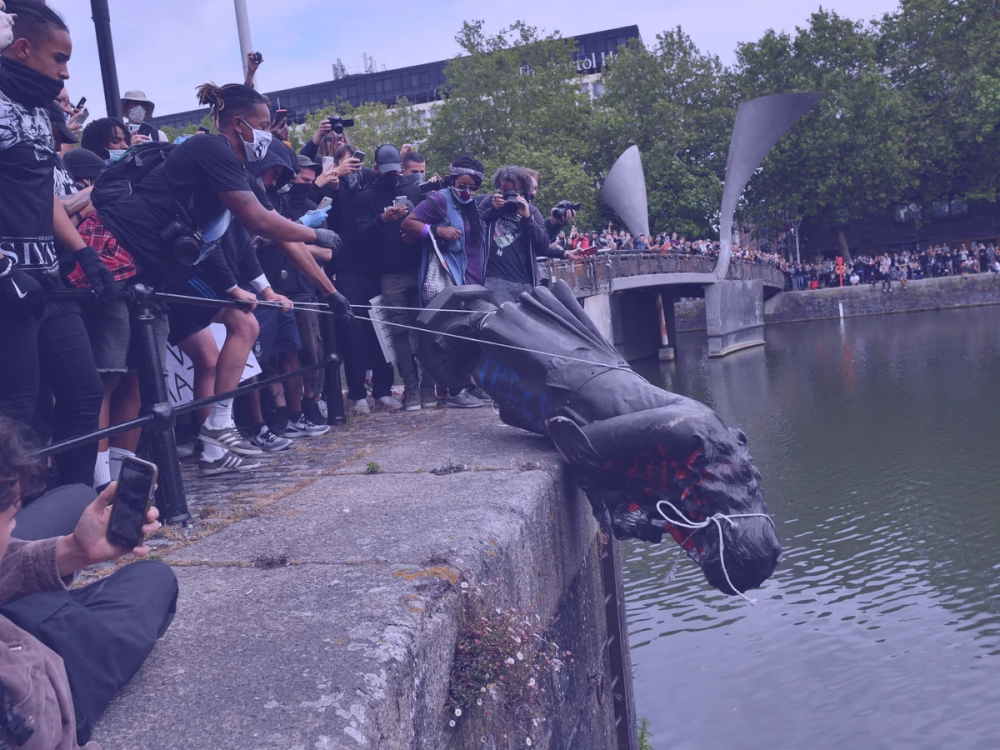
In June 2020, protesters in Bristol pulled down a bronze statue and rolled it into the harbour.
In the final part of our mini-series on three cities that shaped modern Britain, we go back five hundred years to find out how it got there, and why Bristol is still arguing about its past.
Tap a purple word for its meaning. Tap a time to play from there.
[00:00:05] Hello, hello, hello, and welcome to English Learning for Curious Minds, by Leonardo English, the show where you can listen to fascinating stories and learn weird and wonderful things about the world at the same time as improving your English.
[00:00:21] I'm Alastair Budge, and today it's time for the third and final part of our mini-series on three cities that shaped modern Britain.
[00:00:31] In part one, we saw how Edinburgh lost its parliament and became the intellectual capital of the world.
[00:00:39] In part two, we watched Manchester invent the industrial city, and the movements that tried to tame it.
[00:00:47] And today, we finish in the south-west of England, in Bristol, the city that opened England's door to the Atlantic, grew rich on the slave trade, and is still arguing about that history today.
[00:01:02] OK then, let's not waste a minute and get right into it.
[00:01:07] It is the 7th of June, 2020, a Sunday afternoon in the centre of Bristol.
[00:01:15] Thousands of people have marched through the city in support of the Black Lives Matter movement, two weeks after the killing of George Floyd in America.
[00:01:28] The march arrives at a bronze statue of a man in old-fashioned clothes, standing on a stone pedestal. He has stood there, looking down on the city centre, since 1895.
[00:01:44] Ropes appear. They are looped around the statue's head. And within about thirty seconds, a figure that has stood for a hundred and twenty-five years comes crashing down onto the pavement.
[00:02:01] One protester kneels on the statue's bronze neck for eight minutes and forty-six seconds, the length of time that, according to the reports of the day, a police officer had knelt on George Floyd.
[00:02:17] Then the crowd rolls the statue through the streets, hundreds of metres, to the edge of the old harbour, and tips it over the railing into the water.
[00:02:31] The statue was of a man named Edward Colston.
[00:02:37] Pictures of the splash went around the world within hours. Some people cheered; some were horrified. Everyone, suddenly, was talking about Bristol.
[00:02:50] To understand how a bronze statue of a merchant ended up at the bottom of a harbour, we need to go back more than five hundred years, to the time when the city first turned its face towards the ocean.
[00:03:06] Bristol, as you may know, is in the south-west of England, about 200 kilometres west of London and a short drive from the border with Wales.
[00:03:18] Today it's a city of around half a million people, with a long reputation for doing things its own way.
[00:03:27] It grew up around a sheltered river harbour, a few miles inland from the point where the River Avon empties into the sea between England and Wales.
[00:03:40] By the Middle Ages, it was one of the largest towns in England, third only to London and York. Its business was trade:
[00:03:50] woollen cloth going out, and wine coming in.
[00:03:55] Its ships sailed to Ireland, Spain and Portugal. Bristol's merchants made their money from the sea, and its sailors knew the waters leading out into the Atlantic.
[00:04:09] And in the 1490s, a Venetian visitor arrived with a proposal. Instead of following the familiar trading routes, he wanted to sail west across the ocean, hoping to reach Asia.
[00:04:28] His name was Zuan Caboto. The English knew him as John Cabot.
[00:04:35] He had persuaded King Henry VII to give him permission to attempt this voyage.
[00:04:42] The king, however, provided no ships and no money. Cabot needed to find those in Bristol, and find them he did.
[00:04:53] On the 2nd of May 1497, he sailed out of Bristol harbour in a small wooden ship called the Matthew, with a crew of around eighteen men.
[00:05:06] They sailed due west, and seven weeks later, on the 24th of June, they sighted land. It wasn't Asia, of course; it was the east coast of what is now Canada, probably Newfoundland.
[00:05:22] It was the first recorded European landing in mainland North America since the Vikings, five hundred years before.
[00:05:31] Back in England, the king gave Cabot a reward of ten pounds, plus a pension. The royal account book records it, rather wonderfully, as payment "to him that found the new isle".
[00:05:46] The following year, Cabot sailed west again with five ships, and then largely disappears from the historical record. What happened to him remains one of the great mysteries of the age of exploration.
[00:06:02] But the door he had opened stayed open. Fast forward just over a century, and England began planting colonies on the other side of the Atlantic: Virginia, then Barbados, then Jamaica. Virginia grew tobacco, and the Caribbean islands grew sugar.
[00:06:23] And Bristol, facing west, was perfectly placed to trade with them.
[00:06:29] There was one part of the Atlantic trade, though, that Bristol’s merchants were not allowed to touch: the trade in slaves. All English trade with West Africa was legally controlled by a single London company, the Royal African Company.
[00:06:50] Then, in 1698, that changed.
[00:06:55] The monopoly ended, and merchants in other cities were free to enter the business for themselves, the ugly business of trading in human beings.
[00:07:07] Bristol's merchants moved fast. Their ships sailed in a great triangle.
[00:07:15] First, south to West Africa, loaded with brass goods, guns and alcohol, to be exchanged for captive African men, women and children.
[00:07:27] Then came the second side of the triangle, the Atlantic crossing. Hundreds of enslaved people were packed below deck, chained together, with little room to move, little air, and disease spreading through the hold.
[00:07:44] As you will know, many did not survive the journey.
[00:07:48] Those who did were sold in the Caribbean and the American colonies.
[00:07:54] And the ships came home to Bristol loaded with what this enslaved labour produced: sugar, tobacco, rum and cocoa.
[00:08:05] Over roughly a century, ships from Bristol made more than two thousand of these voyages, and carried around half a million enslaved Africans across the Atlantic.
[00:08:20] By the late 1730s, Bristol had become the leading slave port in Britain.
[00:08:28] The enslaved people themselves almost never came to Bristol. A small number arrived as servants. But the vast majority never saw the city that sold them.
[00:08:40] What arrived in Bristol was sweeter: sugar for the city's refineries, tobacco for its factories, and cocoa for its chocolate makers.
[00:08:52] And the money went everywhere: to the shipbuilders and rope makers, to the bankers who lent against the voyages, the sugar refiners and the tobacco merchants.
[00:09:05] And this is where Edward Colston comes back into our story.
[00:09:10] Colston was born in Bristol in 1636, and made his fortune in London as a merchant.
[00:09:19] For twelve years he was a senior official of the Royal African Company, the company that had kept Bristol’s merchants out of the slave trade.
[00:09:31] During his years with the company, its ships carried tens of thousands of enslaved Africans across the Atlantic. Roughly one in five of them died at sea, and those who didn't die on the journey, well, their fate wasn't much better.
[00:09:50] When Colston died in 1721, he left much of his fortune to Bristol: schools, almshouses, which are homes for the poor, and charities for the elderly.
[00:10:06] And Bristol, in return, effectively made him a saint.
[00:10:12] His name went onto streets, schools, office buildings and the city's grandest concert hall. There was even a sweet bun named after him, eaten every year by schoolchildren on Colston Day.
[00:10:28] A child in Bristol could go to a school with his name on it, eat a Colston bun once a year, and grow up walking past his statue in the centre of town. He was the city's greatest selfless benefactor, a wonderful man, as long as you didn't think too much about where all this money came from.
[00:10:50] Not everyone in the city was prepared to keep schtum, though.
[00:10:56] In the summer of 1787, a young clergyman called Thomas Clarkson arrived in Bristol. He had decided to devote his life to ending the slave trade, and he came to one of the great slave ports of the day to gather evidence.
[00:11:17] The ship owners wouldn't talk to him, so he went to the docks instead. In a small pub called the Seven Stars, down a back alley near the harbour, the landlord introduced him to the men who had actually worked the slave ships.
[00:11:35] Clarkson sat and listened, night after night, as ships' surgeons and ordinary sailors described what happened below deck.
[00:11:46] He wrote it all down, and he took it to Parliament. It took twenty years of campaigning, but in 1807, Parliament outlawed the slave trade.
[00:11:59] Now, Bristol's own golden age as a port had actually started to fade as early as the 1740s, as Liverpool took over the slave trade and then the Atlantic trade in general.
[00:12:12] Liverpool had bigger docks and an easier approach from the sea, while Bristol's ships had to creep up a narrow, winding gorge with some of the highest tides in the world.
[00:12:25] This meant that the city had been forced to fight back with engineering.
[00:12:32] In 1809 it completed its Floating Harbour, sealing off two miles of river behind lock gates so that ships in the heart of the city could stay afloat whatever the tide was doing outside.
[00:12:47] But probably the most famous feat of Bristol engineering is a bridge, the Clifton Suspension Bridge, and its designer, a man named Isambard Kingdom Brunel, which is just a great name by the way.
[00:13:02] In 1831, as an unknown twenty-four-year-old, he won a competition to design a bridge over Bristol's Avon Gorge. And he would become the most famous engineer in British history.
[00:13:19] Two years later, he was made chief engineer of the Great Western Railway, which was a railway line to connect London to Bristol.
[00:13:28] At an early board meeting, when someone worried the railway was too long, Brunel is said to have joked: why not make it longer, and have a steamboat go from Bristol to New York, and call it the Great Western?
[00:13:43] It was a joke. He then did it.
[00:13:47] The steamship Great Western, which was built in Bristol, entered service in 1838 as the first steamship designed specifically to cross the Atlantic.
[00:14:00] Five years later, from a Bristol dock, Brunel launched the SS Great Britain, the largest ship in the world, and the first ocean liner built of iron and driven by a propeller.
[00:14:15] The bridge that started it all was finished in 1864, five years after Brunel's death, and you can still see it today.
[00:14:24] The SS Great Britain, too, is still in Bristol today, back in the very dry dock where she was built, a ten-minute stroll from the spot where Cabot's boat still sits on the water.
[00:14:37] Now, let's jump forward to the spring of 1963, as there is one more thing to tell you about Bristol.
[00:14:45] Bristol was doing well.
[00:14:48] The docks were still busy, the factories were hiring, and since the war, several thousand people had arrived from the Caribbean, from Jamaica and Barbados above all, invited to help rebuild a country they had grown up calling "the mother country".
[00:15:06] The city's buses were run by the Bristol Omnibus Company.
[00:15:11] And it had an unwritten rule, never formalised but well known in the city: it did not employ Black or Asian people as drivers or conductors.
[00:15:24] They could work in the canteens and the workshops. They could not work on the buses.
[00:15:31] A youth worker called Paul Stephenson decided to prove it. He arranged a job interview for a young warehouseman called Guy Bailey, who had every qualification the company asked for.
[00:15:47] Then Stephenson telephoned the company and mentioned, in passing, that Mr Bailey was West Indian. He was Black.
[00:15:56] The interview, he was politely informed, was cancelled.
[00:16:01] Stephenson and a small group of fellow campaigners went to the newspapers, and on the 29th of April 1963 they announced a boycott.
[00:16:13] Bristol's Caribbean community, and a good many white Bristolians with them, stopped using the buses.
[00:16:20] They walked, they cycled, they shared cars.
[00:16:24] The story went national. It was raised in Parliament, and Harold Wilson, the leader of the opposition and soon to be Prime Minister, spoke out in support.
[00:16:37] On the 28th of August 1963, the company gave in and announced that they would become what we would call today an "equal opportunities" employer. Sure enough, three weeks later, a Sikh man called Raghbir Singh became the city's first non-white bus conductor.
[00:16:59] And two years after that, Parliament passed the Race Relations Act, the first British law against racial discrimination. The Bristol bus boycott was one of the reasons it existed.
[00:17:14] And this brings us back to the bronze man at the bottom of the harbour.
[00:17:21] Fast forward to the late 20th century, and Bristol's Caribbean community was into its third generation. For many people in that community, the statue was a daily reminder of how the city had made its money.
[00:17:38] The statue of Edward Colston had been put up in 1895, more than a hundred and seventy years after his death, at a time when Victorian Bristol wanted civic heroes and nobody asked too many questions about how they'd made their money.
[00:17:56] Throughout most of the twentieth century, Colston's presence was a non-issue. But from the 1990s onwards, historians, campaigners and many Black Bristolians became more vocal in their questioning, asking why a city with a large Caribbean community was still celebrating a slave trader.
[00:18:20] Paul Stephenson, who was by then in his sixties, was among the loudest of them.
[00:18:26] There were campaigns to rename Colston Hall. There was a long, drawn-out attempt simply to add a second plaque to the statue, explaining his role in the slave trade.
[00:18:38] It collapsed in 2019, when the city couldn't agree on the wording.
[00:18:44] Then came June 2020, the ropes, the splash, and the pictures that went around the world.
[00:18:53] The statue was fished out of the harbour four days later.
[00:18:58] In September 2020, the concert hall dropped Colston's name, and it became the Bristol Beacon.
[00:19:06] Four protesters were put on trial for criminal damage, and in January 2022, a jury found all four not guilty.
[00:19:18] Bristol's famous street artist, Banksy, had a suggestion about what to do with the statue. Put it back on its pedestal, he said, and add bronze figures of the protesters, caught in the act of pulling it down. That way, everyone would be happy.
[00:19:37] The city hasn't taken him up on it.
[00:19:40] The statue itself now lies in a Bristol museum, horizontal, still dented, still covered in spray paint, next to the placards from that day in 2020.
[00:19:52] And the shockwave travelled far beyond Bristol. Within weeks, towns and institutions across Britain were re-examining their own statues, street names and buildings.
[00:20:05] This, as you might imagine, is still a hot potato, and political and public opinion is divided over how modern Britain should deal with its colonial past, and with the legacies of people like Edward Colston.
[00:20:22] The reality is that Bristol wouldn't be Bristol without its past, but the uncomfortable reality is that a lot of that past is not very pleasant to think about.
[00:20:36] OK, then, that is it for today's episode on Bristol, and with that comes the end of this three-part mini-series on three cities that shaped modern Britain.
[00:20:45] I wonder, have you been to any of these cities? All of them? In any case, I hope you found it interesting, and that you've learnt something new.
[00:20:53] If you'd like to keep going with some of these themes, we have episodes on the Transatlantic Slave Trade, which is episode number 447, on the British Empire, which is episode number 109, and even on the rise and fall of Concorde, which was built in Bristol, which is episode 243.
[00:21:14] You've been listening to English Learning for Curious Minds by Leonardo English.
[00:21:19] I'm Alastair Budge, you stay safe, and I'll catch you in the next episode.
Join today and get instant access to 600+ episodes, interactive transcripts, PDF study packs and more.
Become a memberAlready a member? Login
30-day money back guarantee. Cancel anytime.

In June 2020, protesters in Bristol pulled down a bronze statue and rolled it into the harbour.
In the final part of our mini-series on three cities that shaped modern Britain, we go back five hundred years to find out how it got there, and why Bristol is still arguing about its past.

[00:00:05] Hello, hello, hello, and welcome to English Learning for Curious Minds, by Leonardo English, the show where you can listen to fascinating stories and learn weird and wonderful things about the world at the same time as improving your English.
[00:00:21] I'm Alastair Budge, and today it's time for the third and final part of our mini-series on three cities that shaped modern Britain.
[00:00:31] In part one, we saw how Edinburgh lost its parliament and became the intellectual capital of the world.
[00:00:39] In part two, we watched Manchester invent the industrial city, and the movements that tried to tame it.
[00:00:47] And today, we finish in the south-west of England, in Bristol, the city that opened England's door to the Atlantic, grew rich on the slave trade, and is still arguing about that history today.
[00:01:02] OK then, let's not waste a minute and get right into it.
[00:01:07] It is the 7th of June, 2020, a Sunday afternoon in the centre of Bristol.
[00:01:15] Thousands of people have marched through the city in support of the Black Lives Matter movement, two weeks after the killing of George Floyd in America.
[00:01:28] The march arrives at a bronze statue of a man in old-fashioned clothes, standing on a stone pedestal. He has stood there, looking down on the city centre, since 1895.
[00:01:44] Ropes appear. They are looped around the statue's head. And within about thirty seconds, a figure that has stood for a hundred and twenty-five years comes crashing down onto the pavement.
[00:02:01] One protester kneels on the statue's bronze neck for eight minutes and forty-six seconds, the length of time that, according to the reports of the day, a police officer had knelt on George Floyd.
[00:02:17] Then the crowd rolls the statue through the streets, hundreds of metres, to the edge of the old harbour, and tips it over the railing into the water.
[00:02:31] The statue was of a man named Edward Colston.
[00:02:37] Pictures of the splash went around the world within hours. Some people cheered; some were horrified. Everyone, suddenly, was talking about Bristol.
[00:02:50] To understand how a bronze statue of a merchant ended up at the bottom of a harbour, we need to go back more than five hundred years, to the time when the city first turned its face towards the ocean.
[00:03:06] Bristol, as you may know, is in the south-west of England, about 200 kilometres west of London and a short drive from the border with Wales.
[00:03:18] Today it's a city of around half a million people, with a long reputation for doing things its own way.
[00:03:27] It grew up around a sheltered river harbour, a few miles inland from the point where the River Avon empties into the sea between England and Wales.
[00:03:40] By the Middle Ages, it was one of the largest towns in England, third only to London and York. Its business was trade:
[00:03:50] woollen cloth going out, and wine coming in.
[00:03:55] Its ships sailed to Ireland, Spain and Portugal. Bristol's merchants made their money from the sea, and its sailors knew the waters leading out into the Atlantic.
[00:04:09] And in the 1490s, a Venetian visitor arrived with a proposal. Instead of following the familiar trading routes, he wanted to sail west across the ocean, hoping to reach Asia.
[00:04:28] His name was Zuan Caboto. The English knew him as John Cabot.
[00:04:35] He had persuaded King Henry VII to give him permission to attempt this voyage.
[00:04:42] The king, however, provided no ships and no money. Cabot needed to find those in Bristol, and find them he did.
[00:04:53] On the 2nd of May 1497, he sailed out of Bristol harbour in a small wooden ship called the Matthew, with a crew of around eighteen men.
[00:05:06] They sailed due west, and seven weeks later, on the 24th of June, they sighted land. It wasn't Asia, of course; it was the east coast of what is now Canada, probably Newfoundland.
[00:05:22] It was the first recorded European landing in mainland North America since the Vikings, five hundred years before.
[00:05:31] Back in England, the king gave Cabot a reward of ten pounds, plus a pension. The royal account book records it, rather wonderfully, as payment "to him that found the new isle".
[00:05:46] The following year, Cabot sailed west again with five ships, and then largely disappears from the historical record. What happened to him remains one of the great mysteries of the age of exploration.
[00:06:02] But the door he had opened stayed open. Fast forward just over a century, and England began planting colonies on the other side of the Atlantic: Virginia, then Barbados, then Jamaica. Virginia grew tobacco, and the Caribbean islands grew sugar.
[00:06:23] And Bristol, facing west, was perfectly placed to trade with them.
[00:06:29] There was one part of the Atlantic trade, though, that Bristol’s merchants were not allowed to touch: the trade in slaves. All English trade with West Africa was legally controlled by a single London company, the Royal African Company.
[00:06:50] Then, in 1698, that changed.
[00:06:55] The monopoly ended, and merchants in other cities were free to enter the business for themselves, the ugly business of trading in human beings.
[00:07:07] Bristol's merchants moved fast. Their ships sailed in a great triangle.
[00:07:15] First, south to West Africa, loaded with brass goods, guns and alcohol, to be exchanged for captive African men, women and children.
[00:07:27] Then came the second side of the triangle, the Atlantic crossing. Hundreds of enslaved people were packed below deck, chained together, with little room to move, little air, and disease spreading through the hold.
[00:07:44] As you will know, many did not survive the journey.
[00:07:48] Those who did were sold in the Caribbean and the American colonies.
[00:07:54] And the ships came home to Bristol loaded with what this enslaved labour produced: sugar, tobacco, rum and cocoa.
[00:08:05] Over roughly a century, ships from Bristol made more than two thousand of these voyages, and carried around half a million enslaved Africans across the Atlantic.
[00:08:20] By the late 1730s, Bristol had become the leading slave port in Britain.
[00:08:28] The enslaved people themselves almost never came to Bristol. A small number arrived as servants. But the vast majority never saw the city that sold them.
[00:08:40] What arrived in Bristol was sweeter: sugar for the city's refineries, tobacco for its factories, and cocoa for its chocolate makers.
[00:08:52] And the money went everywhere: to the shipbuilders and rope makers, to the bankers who lent against the voyages, the sugar refiners and the tobacco merchants.
[00:09:05] And this is where Edward Colston comes back into our story.
[00:09:10] Colston was born in Bristol in 1636, and made his fortune in London as a merchant.
[00:09:19] For twelve years he was a senior official of the Royal African Company, the company that had kept Bristol’s merchants out of the slave trade.
[00:09:31] During his years with the company, its ships carried tens of thousands of enslaved Africans across the Atlantic. Roughly one in five of them died at sea, and those who didn't die on the journey, well, their fate wasn't much better.
[00:09:50] When Colston died in 1721, he left much of his fortune to Bristol: schools, almshouses, which are homes for the poor, and charities for the elderly.
[00:10:06] And Bristol, in return, effectively made him a saint.
[00:10:12] His name went onto streets, schools, office buildings and the city's grandest concert hall. There was even a sweet bun named after him, eaten every year by schoolchildren on Colston Day.
[00:10:28] A child in Bristol could go to a school with his name on it, eat a Colston bun once a year, and grow up walking past his statue in the centre of town. He was the city's greatest selfless benefactor, a wonderful man, as long as you didn't think too much about where all this money came from.
[00:10:50] Not everyone in the city was prepared to keep schtum, though.
[00:10:56] In the summer of 1787, a young clergyman called Thomas Clarkson arrived in Bristol. He had decided to devote his life to ending the slave trade, and he came to one of the great slave ports of the day to gather evidence.
[00:11:17] The ship owners wouldn't talk to him, so he went to the docks instead. In a small pub called the Seven Stars, down a back alley near the harbour, the landlord introduced him to the men who had actually worked the slave ships.
[00:11:35] Clarkson sat and listened, night after night, as ships' surgeons and ordinary sailors described what happened below deck.
[00:11:46] He wrote it all down, and he took it to Parliament. It took twenty years of campaigning, but in 1807, Parliament outlawed the slave trade.
[00:11:59] Now, Bristol's own golden age as a port had actually started to fade as early as the 1740s, as Liverpool took over the slave trade and then the Atlantic trade in general.
[00:12:12] Liverpool had bigger docks and an easier approach from the sea, while Bristol's ships had to creep up a narrow, winding gorge with some of the highest tides in the world.
[00:12:25] This meant that the city had been forced to fight back with engineering.
[00:12:32] In 1809 it completed its Floating Harbour, sealing off two miles of river behind lock gates so that ships in the heart of the city could stay afloat whatever the tide was doing outside.
[00:12:47] But probably the most famous feat of Bristol engineering is a bridge, the Clifton Suspension Bridge, and its designer, a man named Isambard Kingdom Brunel, which is just a great name by the way.
[00:13:02] In 1831, as an unknown twenty-four-year-old, he won a competition to design a bridge over Bristol's Avon Gorge. And he would become the most famous engineer in British history.
[00:13:19] Two years later, he was made chief engineer of the Great Western Railway, which was a railway line to connect London to Bristol.
[00:13:28] At an early board meeting, when someone worried the railway was too long, Brunel is said to have joked: why not make it longer, and have a steamboat go from Bristol to New York, and call it the Great Western?
[00:13:43] It was a joke. He then did it.
[00:13:47] The steamship Great Western, which was built in Bristol, entered service in 1838 as the first steamship designed specifically to cross the Atlantic.
[00:14:00] Five years later, from a Bristol dock, Brunel launched the SS Great Britain, the largest ship in the world, and the first ocean liner built of iron and driven by a propeller.
[00:14:15] The bridge that started it all was finished in 1864, five years after Brunel's death, and you can still see it today.
[00:14:24] The SS Great Britain, too, is still in Bristol today, back in the very dry dock where she was built, a ten-minute stroll from the spot where Cabot's boat still sits on the water.
[00:14:37] Now, let's jump forward to the spring of 1963, as there is one more thing to tell you about Bristol.
[00:14:45] Bristol was doing well.
[00:14:48] The docks were still busy, the factories were hiring, and since the war, several thousand people had arrived from the Caribbean, from Jamaica and Barbados above all, invited to help rebuild a country they had grown up calling "the mother country".
[00:15:06] The city's buses were run by the Bristol Omnibus Company.
[00:15:11] And it had an unwritten rule, never formalised but well known in the city: it did not employ Black or Asian people as drivers or conductors.
[00:15:24] They could work in the canteens and the workshops. They could not work on the buses.
[00:15:31] A youth worker called Paul Stephenson decided to prove it. He arranged a job interview for a young warehouseman called Guy Bailey, who had every qualification the company asked for.
[00:15:47] Then Stephenson telephoned the company and mentioned, in passing, that Mr Bailey was West Indian. He was Black.
[00:15:56] The interview, he was politely informed, was cancelled.
[00:16:01] Stephenson and a small group of fellow campaigners went to the newspapers, and on the 29th of April 1963 they announced a boycott.
[00:16:13] Bristol's Caribbean community, and a good many white Bristolians with them, stopped using the buses.
[00:16:20] They walked, they cycled, they shared cars.
[00:16:24] The story went national. It was raised in Parliament, and Harold Wilson, the leader of the opposition and soon to be Prime Minister, spoke out in support.
[00:16:37] On the 28th of August 1963, the company gave in and announced that they would become what we would call today an "equal opportunities" employer. Sure enough, three weeks later, a Sikh man called Raghbir Singh became the city's first non-white bus conductor.
[00:16:59] And two years after that, Parliament passed the Race Relations Act, the first British law against racial discrimination. The Bristol bus boycott was one of the reasons it existed.
[00:17:14] And this brings us back to the bronze man at the bottom of the harbour.
[00:17:21] Fast forward to the late 20th century, and Bristol's Caribbean community was into its third generation. For many people in that community, the statue was a daily reminder of how the city had made its money.
[00:17:38] The statue of Edward Colston had been put up in 1895, more than a hundred and seventy years after his death, at a time when Victorian Bristol wanted civic heroes and nobody asked too many questions about how they'd made their money.
[00:17:56] Throughout most of the twentieth century, Colston's presence was a non-issue. But from the 1990s onwards, historians, campaigners and many Black Bristolians became more vocal in their questioning, asking why a city with a large Caribbean community was still celebrating a slave trader.
[00:18:20] Paul Stephenson, who was by then in his sixties, was among the loudest of them.
[00:18:26] There were campaigns to rename Colston Hall. There was a long, drawn-out attempt simply to add a second plaque to the statue, explaining his role in the slave trade.
[00:18:38] It collapsed in 2019, when the city couldn't agree on the wording.
[00:18:44] Then came June 2020, the ropes, the splash, and the pictures that went around the world.
[00:18:53] The statue was fished out of the harbour four days later.
[00:18:58] In September 2020, the concert hall dropped Colston's name, and it became the Bristol Beacon.
[00:19:06] Four protesters were put on trial for criminal damage, and in January 2022, a jury found all four not guilty.
[00:19:18] Bristol's famous street artist, Banksy, had a suggestion about what to do with the statue. Put it back on its pedestal, he said, and add bronze figures of the protesters, caught in the act of pulling it down. That way, everyone would be happy.
[00:19:37] The city hasn't taken him up on it.
[00:19:40] The statue itself now lies in a Bristol museum, horizontal, still dented, still covered in spray paint, next to the placards from that day in 2020.
[00:19:52] And the shockwave travelled far beyond Bristol. Within weeks, towns and institutions across Britain were re-examining their own statues, street names and buildings.
[00:20:05] This, as you might imagine, is still a hot potato, and political and public opinion is divided over how modern Britain should deal with its colonial past, and with the legacies of people like Edward Colston.
[00:20:22] The reality is that Bristol wouldn't be Bristol without its past, but the uncomfortable reality is that a lot of that past is not very pleasant to think about.
[00:20:36] OK, then, that is it for today's episode on Bristol, and with that comes the end of this three-part mini-series on three cities that shaped modern Britain.
[00:20:45] I wonder, have you been to any of these cities? All of them? In any case, I hope you found it interesting, and that you've learnt something new.
[00:20:53] If you'd like to keep going with some of these themes, we have episodes on the Transatlantic Slave Trade, which is episode number 447, on the British Empire, which is episode number 109, and even on the rise and fall of Concorde, which was built in Bristol, which is episode 243.
[00:21:14] You've been listening to English Learning for Curious Minds by Leonardo English.
[00:21:19] I'm Alastair Budge, you stay safe, and I'll catch you in the next episode.


